
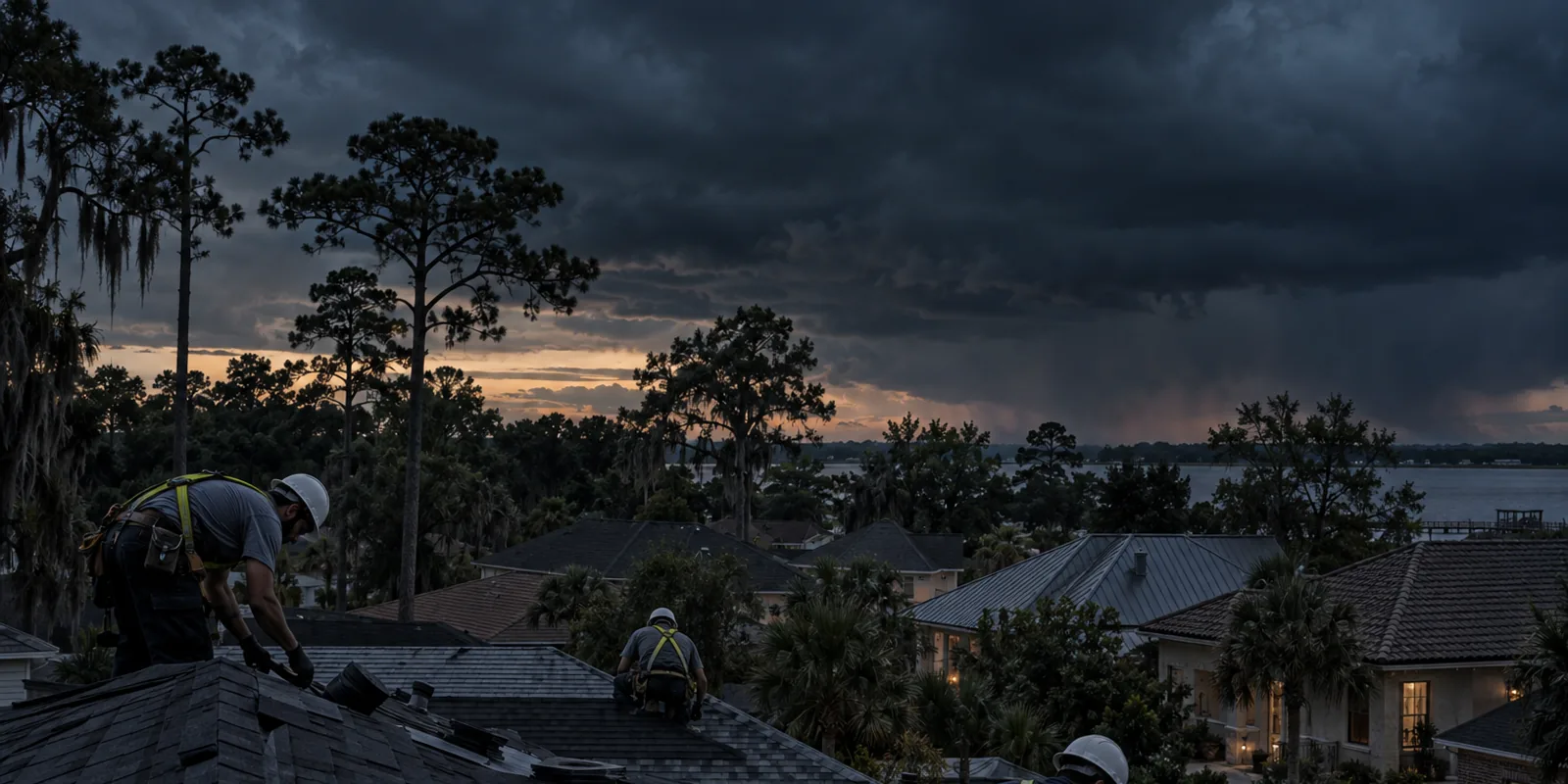
Tile roofs are a small share of the roofs in Jacksonville but a large share of the expensive misunderstandings. They sit on the estate homes of Ponte Vedra Beach around TPC Sawgrass and the Ponte Vedra Inn & Club, in Deerwood and the Deerwood Country Club area off Baymeadows Rd, at Queen’s Harbour on the Intracoastal, and on a scattering of 1990s and 2000s homes in Mandarin and Julington Creek. Owners are often told the roof will last 50 years, which is true of the tile and not true of the roof. This page explains what is actually keeping water out of a tile house, why that layer fails at 20 to 30 years in Florida, how broken and slipped tiles are replaced, what happens at ridges, hips, valleys and eaves, what a tile re-lay involves, and how the roofer handles matching, slate, weight and walking on the roof.
Tile roofs in Jacksonville and Ponte Vedra
Concrete tile from Eagle and Boral, now Westlake, dominates the tile roofs in Duval and St. Johns counties, in flat, S-profile and barrel shapes. Clay tile, lighter in weight and longer-lived in color, is on some higher-end Ponte Vedra Beach and Mandarin homes and on older Mediterranean-style houses in San Marco and Ortega. Both were installed on battens or direct-nailed, with the first course set on bird stops at the eave and the ridges and hips bedded in mortar or, on newer roofs, foam adhesive with a mortar or metal finish. Slate exists but is rare, and is covered below.
Tile does well in Jacksonville’s climate in one respect: it does not burn in the sun, it does not blow off as easily as shingles when installed to the Florida Building Code’s fastening requirements, and it shrugs off hail. What it does not do is keep water out by itself.
The underlayment is the real roof
Rain hits the tile, most of it runs off, and some of it always gets under. Wind-driven rain from an afternoon storm or a nor’easter pushes water up under the head laps and through the side joints; water tracks along the underside of the tile at the eaves; and at valleys and roof-to-wall junctions a great deal of water runs beneath the tile rather than over it. The underlayment on the deck is designed to catch all of that and carry it to the gutter. When the underlayment is intact, the roof does not leak no matter how many tiles are cracked. When the underlayment fails, the roof leaks even if every tile is perfect.
The problem is heat. The air space under a tile roof in a Jacksonville August reaches temperatures that dry out felt and older modified bitumen underlayments. Somewhere between 20 and 30 years, sometimes sooner on the south and west slopes, the material becomes brittle, cracks at the battens and nail heads, and tears when a tile shifts. The first leaks show up at the eaves, valleys and around penetrations, where the most water travels beneath the tile. A leak on a tile roof of that age is a sign the underlayment is at the end of its life across the slope, not just at the stain.
Cracked, slipped and broken tiles
Tiles break for three main reasons in this area. Foot traffic is the biggest: HVAC technicians, satellite installers, pressure-washing crews and homeowners cracking tiles by stepping in the middle of the tile rather than on the head where it is supported. Falling limbs from the live oaks and pines that surround so many homes in Mandarin and along Julington Creek are the second. Age and frost are minor factors here compared to the North, but concrete tiles do erode at the surface and clay tiles can craze and spall over decades.
A slipped tile has usually lost its fastener, its clip, or the batten beneath it has rotted from a leak the owner did not know about. Sliding it back and hoping is not a repair. The roofer lifts the tiles above, checks the batten and the underlayment beneath, refastens or replaces what has failed, and reseats the tile. Broken tiles are removed, the underlayment beneath them inspected and patched with a compatible membrane if it has been cut, and the replacement tile clipped, nailed or foamed to match the original system. A cluster of cracked tiles in a line is a walking path, and the report will say so, because that is a claim against whoever walked it rather than wear and tear.
Ridges, hips, valleys and bird stops
The ridge and hip tiles are bedded in mortar on older roofs and foam adhesive on newer ones, with a mortar or metal weather block at the joints. Mortar shrinks and cracks under Florida heat cycling, pieces fall into the gutters, and wind-driven rain enters at the top of the roof and runs down under the field tiles. Rebedding and repointing the ridges is one of the most common tile repairs on 1990s homes in Deerwood and Ponte Vedra Beach and it stops leaks that appear all over the house.
Valleys carry a large volume of water beneath the tile in a metal channel. Galvanized valley metal rusts through near the coast, and pine needles and oak leaves piled against the tile edges dam the valley so water rides up under the tiles on either side. A failed valley is rebuilt by lifting the tiles along its length, replacing the metal with a heavier or coastal-grade material, renewing the underlayment on both sides and relaying the tiles.
Bird stops are the closures at the eave that fill the gap under the first course of a barrel or S-profile tile. When they are missing or broken, wind-driven rain enters the roof at its lowest and most vulnerable point, and wasps, birds and squirrels move in behind them. They are replaced during any eave work and checked on every inspection. The roof leak repair page explains how a stain in the house is traced back to which of these details has failed.
Tile re-lay: keeping the tile, replacing the roof
When the underlayment has failed across the roof, the answer is a re-lay. The tiles are lifted and stacked, either on the roof in planned piles or on pallets on the ground. Old underlayment and battens are stripped to the deck, the deck is inspected, rotted boards are replaced and the rest renailed to current spacing. New self-adhered underlayment goes down as the sealed roof deck the Florida Building Code requires, new battens are set, and all flashings, valley metal and bird stops are replaced. The original tiles are relaid, broken ones replaced with matches, and the ridges and hips rebedded with foam adhesive and finished. The house looks exactly as it did before, with a roof that is new underneath.
A re-lay is a re-roof for permit purposes. In Duval County the permit comes from the City of Jacksonville or the Beaches city; Ponte Vedra Beach is St. Johns County. The inspector checks the deck, the underlayment and the fastening before the tiles go back. Because the tile is reused, the cost sits between a repair and a new tile roof, and the post on what drives roof repair cost in Jacksonville explains the variables. When tiles are too eroded or too many are unmatchable, the alternatives are a new tile roof or a switch to metal or shingle, both covered on the roof replacement page.
Matching tiles, slate and the weight question
Matching discontinued tile is a regular part of the work. The roofer identifies the manufacturer, profile and color and checks reclaimed tile yards that buy salvaged tiles from re-roofs across Florida. When no match exists, original tiles are harvested from a hidden slope or from behind a chimney to make the visible repair, and the near-match goes where nobody sees it.
Slate is uncommon in Jacksonville, limited to some historic homes in Riverside and Ortega and a few custom builds in Ponte Vedra Beach. It is repaired with slate rippers, matched slates on copper hooks, and replacement of the copper flashings that usually fail before the stone does. It is heavy and unforgiving to walk, and the roofer will be candid about whether a particular slate roof is within their scope.
Weight is the question behind every change of material. A house built for tile carries it easily; a house built for shingles generally cannot take concrete tile without an engineer’s assessment and reinforcement. The Ponte Vedra Beach area page covers the tile-heavy neighborhoods where these conversations happen most.
Walking on a tile roof
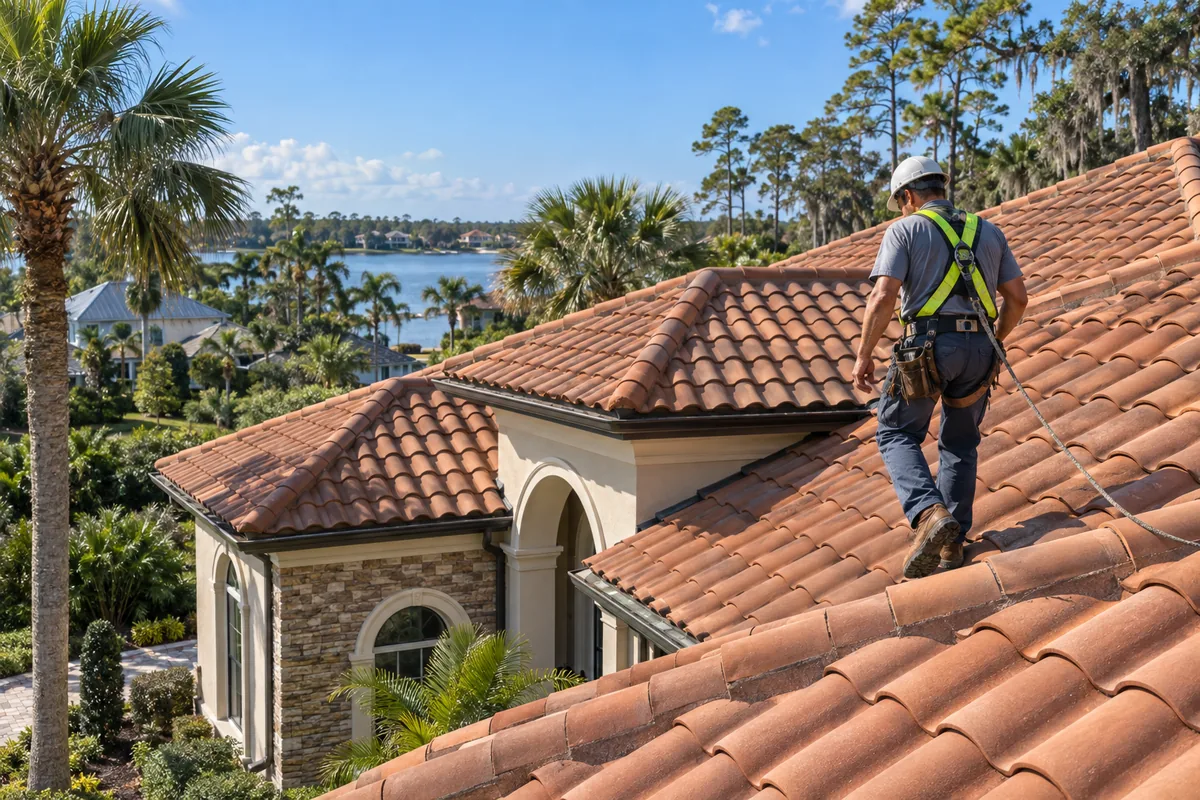
Every tile inspection starts with how to get across the roof without adding to the damage. The roofer steps on the heads of the tiles, where the tile below supports them, never in the unsupported middle of a barrel or S-tile, and uses foam pads, roof ladders or a lift on steep or fragile roofs. Broken tiles found along the way are noted and replaced as part of the job. If a technician needs to reach a rooftop unit or a satellite dish, the roofer can lay a protected path for them. It is the least glamorous part of tile roofing in Florida and the one that saves owners the most money.
What is included
- Roof walk on the tile heads and an attic inspection to find where the underlayment, not the tile, is letting water through
- Cracked, chipped and slipped tiles lifted and replaced with matched tiles, clipped or foamed as the original system requires
- Ridge and hip tiles rebedded with mortar or foam adhesive and repointed where the old bedding has crumbled
- Valley metal, headwall and sidewall flashings replaced beneath the tile with the tiles relaid on top
- Bird stops and eave closures replaced so wind-driven rain, wasps and birds stay out of the first course
- Tile re-lay: tiles lifted and stacked, new underlayment and battens installed, tiles relaid with new ridge work
- Slate repairs with matched slate, copper hooks and replaced flashings on the rare slate roofs in the area
- Written report with photos of the underlayment condition and remaining life for your insurer
Signs you should call
- A ceiling stain on a tile roof, which means the underlayment has failed and the tile has been shedding water onto it for a while
- Broken or missing tiles visible from the ground, especially after a limb comes down or someone walks the roof
- Tiles that have slid out of line, exposing the course below or the underlayment
- Crumbling mortar or gaps at the ridges and hips, with pieces of it in the gutters
- Underlayment showing at the eave or turning to powder when touched
- A tile roof between 20 and 30 years old that has never had its underlayment inspected
- Insurance asking for a roof inspection or condition report before renewing
Please do not walk on your tile roof
Concrete and clay tiles crack under a boot placed in the wrong spot, and a homeowner checking one broken tile usually creates three more. The tiles are also slick when wet or when algae has grown on the shaded side. If you can see a broken tile or a stain inside, photograph it from the ground and call. The roofer walks tile on the heads of the tiles where they are supported, and uses foam pads or roof ladders on steep or fragile roofs.
Frequently asked questions
Why is my tile roof leaking when the tiles look fine?
Because the tiles were never the waterproof layer. Concrete and clay tiles shed most of the rain, but water gets under them at every storm, through the joints, at the eaves and especially in wind. The underlayment beneath the tile is what keeps that water out of the house. In Florida the older 30-pound felt and early modified underlayments last roughly 20 to 30 years under the heat that builds under tile, and then they dry out, crack and tear. A leak on a tile roof with no visible tile damage almost always means the underlayment has reached that point somewhere on the slope.
What is a tile re-lay and when is it the right choice?
A re-lay keeps your existing tiles and replaces everything beneath them. The tiles are lifted and stacked on the roof or on the ground, old underlayment and battens are stripped, the deck is inspected and renailed, new peel-and-stick underlayment and battens are installed to the Florida Building Code, and the same tiles are relaid with new ridge and hip work and new flashings. It is the right choice when the tiles are sound and matchable but the underlayment has failed across the roof. It costs less than new tile and keeps the look of the house, which matters in HOA neighborhoods like Deerwood and Queen's Harbour.
Can broken tiles be matched if the tile is discontinued?
Frequently yes, with some searching. Tile manufacturers such as Boral, now Westlake, and Eagle change profiles and colors over the years, and many homes in Ponte Vedra Beach and Mandarin have tiles that are no longer produced. The roofer identifies the profile and color, checks reclaimed tile suppliers who stock salvaged tiles from re-roofs, and, when an exact match is not available, uses matched tiles in a hidden location such as behind a chimney or on a rear slope and moves original tiles from there to the visible repair. Photos of the options are shown before any tile is ordered.
How do I know if my tile roof is 'walking damage' or age?
Walking damage shows as tiles cracked across the middle or at the corners in a line or cluster, usually along the path someone took to a satellite dish, a skylight, a chimney or an HVAC unit, and often on otherwise sound roofs. Age shows as widespread surface erosion on concrete tiles, crazing on clay, crumbling ridge mortar, and underlayment that is brittle when lifted. Storm damage from a limb is obvious. The report separates these because it matters for insurance: a roof damaged by a technician or a storm is a different claim from a roof that has simply reached the end of its underlayment life.
Is a tile roof too heavy for my house?
If your house was built with tile, the trusses were engineered for it and re-laying the same tile is fine. Concrete tile weighs several times what asphalt shingles weigh, so switching a shingle roof to tile requires an engineer to confirm the structure can carry it, and often it cannot without reinforcement. Going the other way, from tile to shingle or metal, is a weight reduction and is done regularly when tiles are unmatchable or the owner wants a lighter roof. Slate is heavier still, which is one reason it is rare in Jacksonville. The roofer raises the structural question before proposing any change in material.
Do you repair slate roofs in Jacksonville?
Yes, though there are few of them. A handful of older homes in Riverside, Avondale and Ortega and some custom homes in Ponte Vedra Beach have natural or synthetic slate. Slate repair uses a slate ripper to remove the broken piece, a matched slate slipped into place and secured with a copper hook or a nail and bib, and replacement of the copper or lead flashings that usually fail before the slate does. Synthetic slate is handled more like a shingle. Slate takes different tools and a lighter step than concrete tile, and the roofer will say plainly whether a given roof is one they should take on.
Does a tile roof repair need a permit in Duval County?
Replacing a few broken tiles or repointing a ridge does not. A tile re-lay is a re-roof under the Florida Building Code, because the underlayment, which is the actual water barrier, is being replaced, and it needs a permit from the City of Jacksonville Building Inspection Division, from the relevant Beaches city, or from St. Johns County for Ponte Vedra Beach. Valley and flashing replacement beneath the tile may need one depending on the extent. The roofer pulls the permit under their DBPR license and the inspector checks the underlayment and fastening before the tiles go back on.