
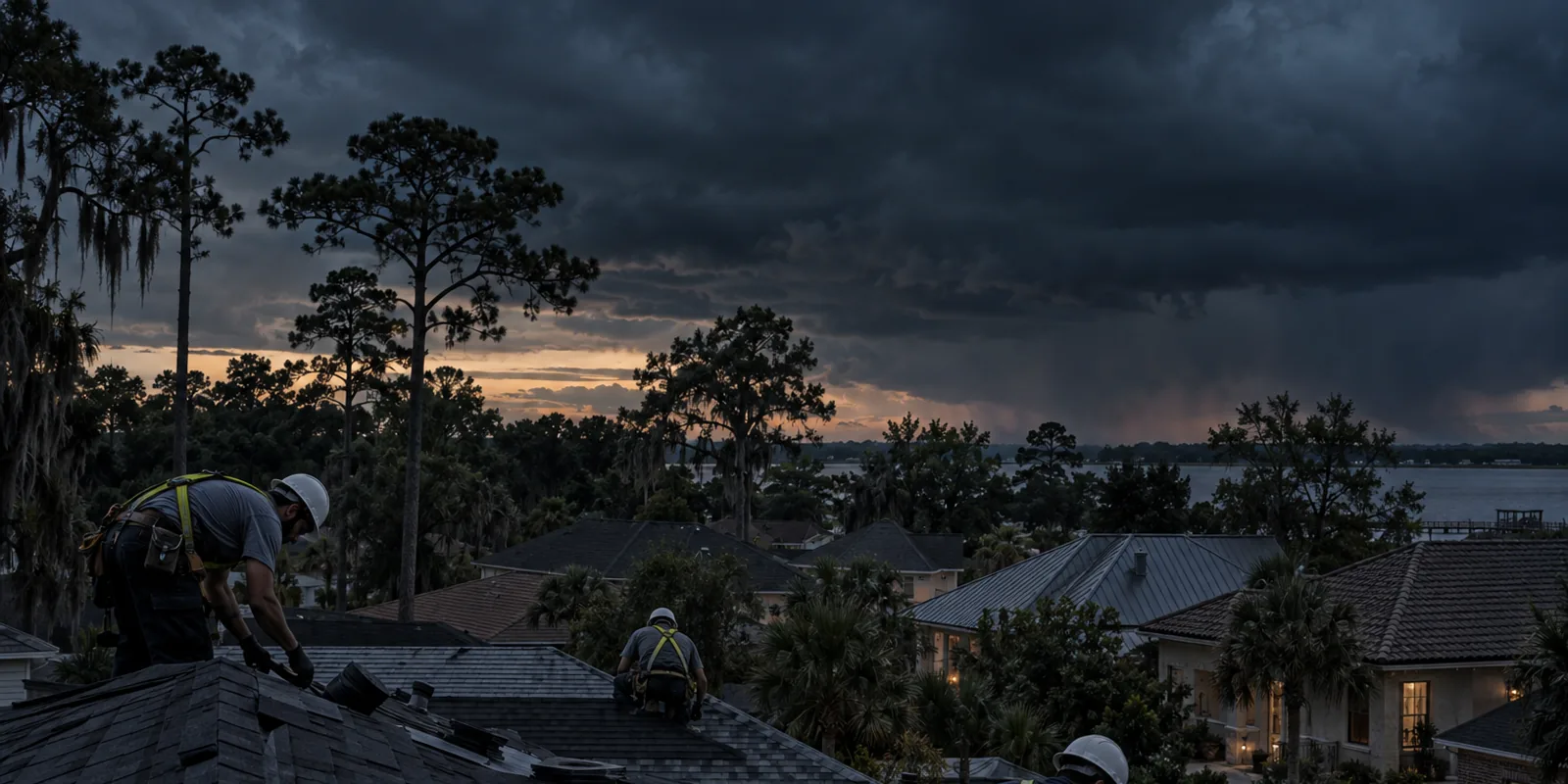
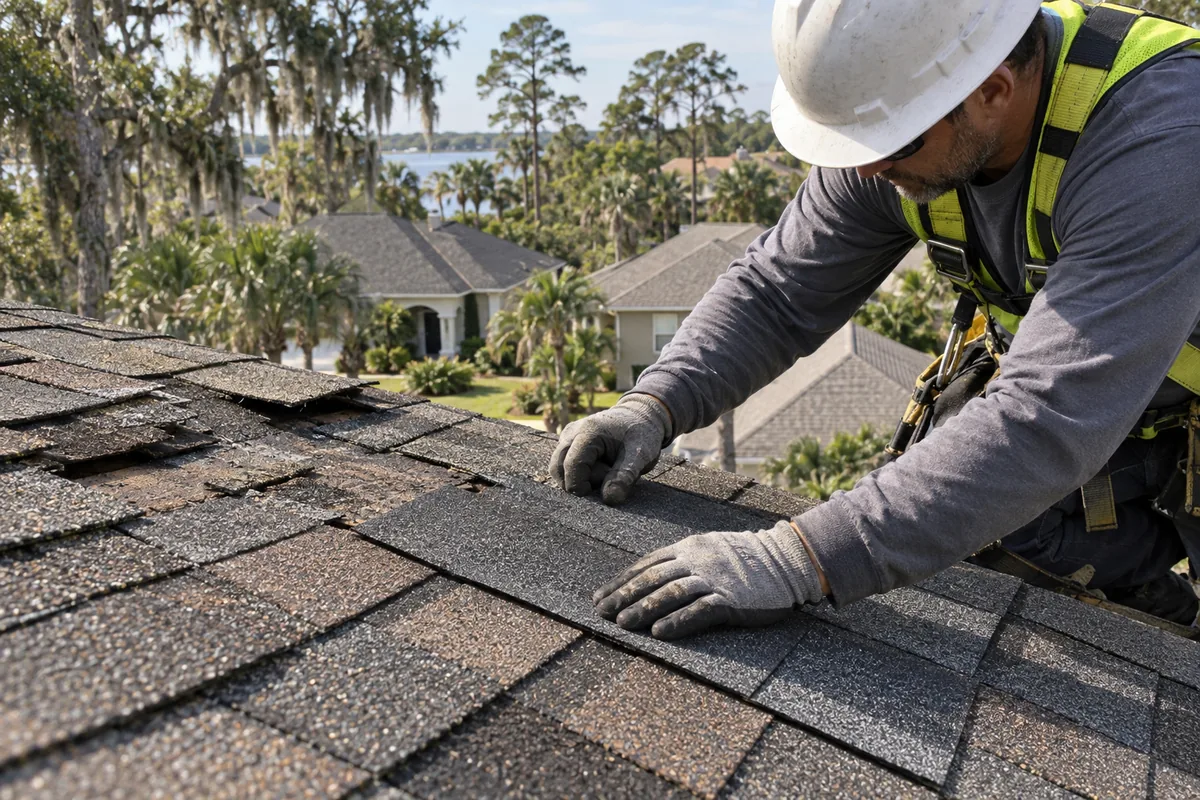
Most roofs in Duval County are asphalt shingle, and most of the repair calls a Jacksonville roofer takes are for them. The 1980s and 1990s subdivisions in Mandarin, Baymeadows, Argyle Forest and Orange Park were built with 3-tab shingles that are now at or past the end of their life. The 2000s and 2010s neighborhoods in Bartram Park, Oceanway, eTown and around the St. Johns Town Center have architectural shingles that are holding up better but still take a beating from sun, wind and algae. This page explains how Florida weather ages an asphalt roof, which repairs are routine, how discontinued shingles are matched, when the 25 percent rule and SB 4-D come into play, and what keeps a manufacturer warranty valid.
The shingles on Jacksonville roofs
Three-tab shingles are a single flat layer with cutouts that create the look of three separate tabs. They are light, inexpensive and, in Florida sun, short-lived: 12 to 18 years is typical here. Their tabs are also easy for wind to catch. Architectural, or dimensional, shingles are laminated from two layers, heavier, rated for higher wind speeds, and last considerably longer. Nearly every replacement in Jacksonville today uses architectural shingles from GAF, Owens Corning, CertainTeed, Atlas or TAMKO.
Algae-resistant shingles matter here more than almost anywhere. Gloeocapsa magma, the blue-green algae behind the black streaks on north-facing slopes from Mandarin to Oceanway, feeds on the limestone filler in asphalt shingles and thrives in humidity and shade under live oaks and magnolias. AR shingles contain copper or zinc granules that suppress it. If your roof was installed before AR shingles became standard, streaks are close to inevitable, and the maintenance and inspection page covers safe soft-wash treatment.
How sun and heat age an asphalt roof
The Florida sun does most of the damage. Ultraviolet light dries the asphalt in the shingle, the granules that protect it loosen and wash into the gutters, and the exposed asphalt bakes, shrinks and curls at the edges. Blistering shows up as small raised bumps where moisture trapped in the shingle during manufacturing or installation expands in the heat; when the blisters pop they leave bare asphalt. Attic temperatures well above 130 degrees on a summer afternoon cook the shingle from below when soffit and ridge ventilation are inadequate, which is the case on many older ranch homes in Arlington and Cedar Hills with blocked soffits.
Nail pops come from the same heat cycling. The decking expands and contracts, nails driven short or into a knot work upward, and the head lifts the shingle above it. Each pop is a small tent that catches wind and lets water under the shingle. The repair is to pull the nail, drive a new one into sound wood beside the old hole, seal the hole, and reseal the shingle. Simply hammering the pop back down lasts until the next hot week.
Wind damage: lifted tabs, ridge caps and sealing strips
Wind uplift is the most common storm damage in Jacksonville, and the roof’s edges take the brunt. Rakes, eaves and ridge caps see the highest suction in a gust, which is why the Florida Building Code requires six nails per shingle and tighter nailing along the perimeter in high-wind areas. A tab that lifts and drops back may look fine from the ground but has a crease across it that will crack open in a few months. A tab that tears off leaves the shingle below exposed at its nail line.
Nor’easters in fall and winter are particularly good at finding weak shingles. Days of sustained wind from the northeast, with rain, work at the leading edge of every tab on the windward slopes. Homes at the Beaches and along the Intracoastal see this every year. Ridge caps, which are the most exposed shingles on the roof, crack along the bend and blow off in strips.
Every asphalt shingle has a factory sealing strip that softens in heat and bonds the tab to the shingle beneath it. In summer that takes a day. In cool weather it can take weeks, so the roofer hand-seals every replaced tab with roofing cement. Sealing strips also fail with age; a shingle whose strip has dried out is loose even on a calm day, and lifting a few tabs during the inspection is how the roofer checks that.
Valleys, pipe boots and the leaks that are not the shingles
The single most common leak on a Jacksonville shingle roof is not a shingle. It is the neoprene collar on a plumbing vent boot. After about ten years of UV the rubber cracks in a ring around the pipe, and water runs down the outside of the pipe into the ceiling of the bathroom or kitchen below. Replacing the boot is a small job. Ignoring it rots the decking around the pipe.
Valleys collect water from two slopes and, under pines and live oaks, collect needles and leaves that hold that water against the shingles. Closed-cut valleys wear through where the debris sits; open metal valleys rust at the coast. A valley that leaks is rebuilt with new metal or an ice-and-water membrane and new shingles on both sides. Chimneys, skylights and roof-to-wall junctions rely on step flashing and counterflashing, and where a wall meets a roof edge a kick-out diverter keeps water out of the siding. Missing kick-outs are common on 1990s homes and cause rot that shows up in the wall rather than the ceiling. The roof leak repair page explains how a leak is traced from the stain back to the source.
Matching discontinued shingles
Shingle lines and colors come and go, and a roof from 2005 may use a product that has not been made for years. The roofer takes a sample, identifies the brand and color, and looks first at the same manufacturer’s current equivalent and then at comparable lines from others. Photos of the closest matches are shown before anything is ordered. A repair on a rear or side slope with a near match is usually invisible from the street. A front slope is a judgment call; some homeowners accept a slight difference, others in HOA neighborhoods like those around the Town Center and in Bartram Park prefer to replace the entire visible slope so the roof reads as one color. Either way the choice is made before the work, not after.
Repair, partial replacement and the 25 percent rule
Florida’s 25 percent rule caused a lot of unnecessary full replacements for years: under older code, if more than a quarter of a roof section was repaired or replaced in twelve months, the whole section had to be brought to current code. Senate Bill 4-D in 2022 exempted roofs built or replaced under the 2007 Florida Building Code or later, which covers most homes reroofed since then. Older roofs may still be subject to it. The practical question is the age and permit history of your roof, and the roofer checks the City of Jacksonville permit records before proposing a repair large enough for the rule to matter. Ask which rule applies before signing anything.
A partial replacement of one slope is a legitimate middle option when wind or age has ruined one side and the rest of the roof is sound, and it needs a permit like any reroof. The roof replacement page covers full replacement, and the post on roof repair cost in Jacksonville explains what moves the price of each option without quoting numbers.
Warranties and ventilation
Manufacturer warranties on shingles come with conditions that matter in Florida. The shingles must be installed to the manufacturer’s specification and the building code, which in Duval County means six nails, a sealed deck or approved underlayment, proper drip edge and starter strips. The attic must be ventilated to the manufacturer’s ratio of soffit intake to ridge or off-ridge exhaust. Poor ventilation shortens shingle life in humid heat and can void the warranty outright. When the roofer repairs a roof, blocked soffit vents, missing baffles and a ridge without a vent are noted in the report, because fixing them is often the cheapest thing you can do to make the shingles last. Insurers care too: an inspection showing an aging shingle roof with good ventilation and no active leaks is what keeps a policy renewable in Florida.
What is included
- Full walk of the roof plus an attic check, with every slope, ridge, valley and penetration photographed
- Wind-lifted, creased or missing shingles and ridge caps replaced and hand-sealed
- Nail pops backed out, re-nailed in fresh decking and the shingle above resealed
- Cracked neoprene pipe boots replaced with new boots or lead-and-boot combinations
- Valley metal, step flashing and chimney counterflashing repaired or rebuilt
- Discontinued shingles matched as closely as available stock allows, with photos for your approval
- Rotted decking at eaves and around leaks cut out and replaced with permit filing when required
- Written report noting whether the damage is storm-related or wear, for your insurance file
Signs you should call
- Shingle tabs flapping or missing after a windy night, especially on the northeast slope
- Ridge cap shingles cracked, curled or blown off along the top of the roof
- Piles of granules in the gutters or at the bottom of downspouts
- Shingles curling at the edges, cupping or blistering in the afternoon sun
- Small bumps in the shingle surface, which are nail heads pushing up from below
- A ceiling stain near a bathroom or kitchen vent, which usually points to a cracked pipe boot
- Black streaks spreading across north-facing slopes that never seem to dry out
After a storm, resist the urge to climb up and look
A shingle roof after a storm may have loose tabs, wet algae and hidden soft spots in the decking, and the pitch on many Jacksonville homes is steeper than it looks from the driveway. Photograph what you can see from the ground and from a window, put a bucket under any drip, and call. The roofer will tarp an open area first if more rain is coming and do the permanent repair once the roof is dry.
Frequently asked questions
Can a shingle roof be repaired, or do I need a whole new roof?
Most shingle roofs in Jacksonville are repaired several times before they are replaced. Wind-lifted tabs, a run of missing ridge caps, a cracked pipe boot, a nail pop, a failed valley or a chimney flashing are all repairs, and a good repair on an otherwise sound roof lasts as long as the roof around it. Replacement becomes the right call when the shingles across whole slopes are brittle, curling and shedding granules, when repairs would need to be repeated every season, or when the roof's age is causing your insurer to threaten non-renewal. The inspection and written estimate tell you which situation you are in.
What is the 25% rule and does it apply to my roof?
Under older Florida Building Code rules, if more than 25 percent of a roof section was repaired or replaced within twelve months, the whole section had to be brought up to current code, which usually meant full replacement. Senate Bill 4-D in 2022 changed that: a roof built or replaced under the 2007 code or later can be repaired regardless of how much is being worked on. Roofs older than that may still fall under the 25 percent rule. Ask the roofer which rule applies to your roof's age and permit history before agreeing to any large repair.
Why are my shingles wearing out faster than the warranty says?
Florida sun is harder on asphalt than the climate the warranty was written for. Intense UV dries the asphalt, granules loosen and wash into the gutters, and without granules the shingle bakes and curls. Attic heat from poor ventilation cooks the shingle from underneath as well, and humidity feeds algae on shaded slopes. In Jacksonville a 3-tab shingle commonly lasts 12 to 18 years and an architectural shingle longer, but rarely the full number on the wrapper. Manufacturer warranties also require proper ventilation and installation, and a roof without soffit and ridge vents may not qualify for a claim.
Why does wind lift shingles on one side of my house but not the other?
Nor'easters and most tropical systems push wind from the northeast, so the northeast-facing slopes and their rakes and eaves take the brunt of it. Wind gets under the leading edge of a tab, breaks the seal strip and creases or tears the shingle. Ridge caps are exposed on both sides and go first. The slopes that face away from the wind are in the lee and often untouched. When the roofer finds wind damage on one slope, the report notes the direction so the insurer can see it is consistent with the storm rather than with age.
Can you match shingles that are no longer made?
Often closely, rarely perfectly. Manufacturers change colors and discontinue lines, and even a shingle of the same name has weathered on your roof for years while the new one has not. The roofer identifies the brand and color from a sample, checks current stock from the same manufacturer and comparable lines from others, and shows you photos of the closest options. On a rear slope a near match is usually acceptable; on a front slope facing the street some homeowners choose to replace the whole slope instead. That decision is yours and it is laid out in the estimate.
Why does my new shingle repair look loose in cool weather?
Asphalt shingles have a factory strip of adhesive that softens in heat and bonds the tab to the shingle below. In a Jacksonville summer that happens within a day or two. In December and January the strip may not activate for weeks, and a repair done in cool weather is hand-sealed with roofing cement under each tab so it does not wait for the sun. If a repair was not hand-sealed and a cold front brings wind before the strips have bonded, tabs can lift. That is an installation shortcut, not a shingle problem, and it is easy to avoid.
Is the leak really the shingles, or something else?
More often something else. The most common leak source on a Jacksonville shingle roof is a cracked neoprene collar on a plumbing vent boot, which splits after ten years or so of UV and lets water run straight down the pipe into a bathroom ceiling. Valleys under pine needles, chimney and skylight flashing, roof-to-wall junctions without kick-out diverters, and nail pops account for most of the rest. The shingles themselves fail by wind or age across a slope, not usually with a single drip. That is why the inspection covers every penetration and flashing before blaming the shingle.