
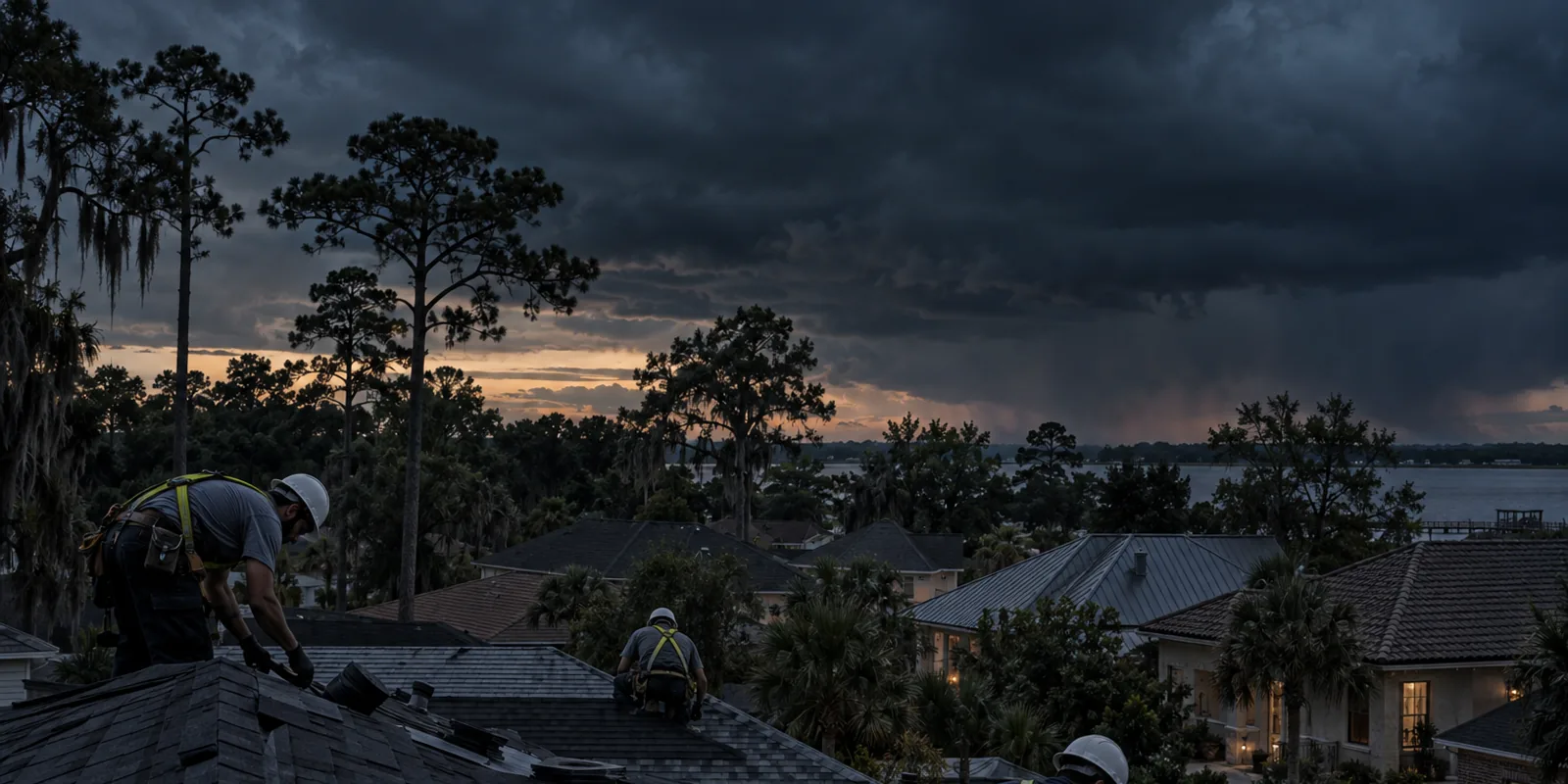
Most roofs being replaced in Jacksonville today were installed in the late 1980s through the early 2000s, when 3-tab shingles were the default on new subdivisions from Mandarin to Argyle Forest. Twenty summers of Florida sun, afternoon thunderstorms and humidity have done their work, and insurers have started asking about roof age at renewal. This page explains how a replacement is decided, what a code-compliant tear-off includes under the Florida Building Code, how permits, the 25 percent rule and insurance fit in, and what to expect on the day the crew arrives.
When replacement makes more sense than repair
A roof earns a replacement when the shingles themselves have failed, not just one detail on them. Granules washing into the gutters, tabs curling at the corners, shingles that crack when a roofer lifts them to reseal, and leaks in several unrelated places all point to a mat that has lost its oils to the sun. On the other hand, a cracked pipe boot collar, a wind-lifted ridge cap or a bad valley on an otherwise sound roof is a roof leak repair, and it should be priced as one.
Age is the other measure. 3-tab shingles commonly last 12 to 18 years in Duval County, architectural shingles longer, and the decking under a 1960s Arlington ranch may have been through two or three roofs already. The roofer looks in the attic for stained or delaminated plywood, checks whether the shingles still seal to each other, and reads the permit history. The estimate says which option is honest for your roof. If repair is the right call, that is what is written, because a replacement sold to a roof with five years left is not a service to anyone.
Tear-off, decking and what goes under the shingles
Florida code permits up to two layers of asphalt shingles, but in Jacksonville tear-off is the norm, and for good reasons. Stripping to the wood deck is the only way to see rot at the eaves from clogged gutters, soft spots around old skylights, and plywood that has delaminated from years of attic heat. Bad sheets are replaced. The rest of the deck is re-nailed with ring-shank nails on the spacing the Florida Building Code requires, which is one of the items a wind mitigation inspector checks later.
On top of the deck goes the secondary water barrier. A peel-and-stick membrane over the whole deck, or an approved synthetic underlayment with the seams sealed, keeps water out if wind ever strips shingles during a tropical storm. New drip edge goes on at the eaves and rakes, metal in the valleys, new step flashing where the roof meets a wall, and new boots at every pipe. Old flashing is not reused. Ventilation is set up as a balanced system of soffit intake and ridge exhaust, because a hot, damp attic bakes shingles from below and can void the manufacturer warranty.
Choosing the covering: shingles, metal or tile
Architectural shingles are the standard replacement across most of Jacksonville, from Baymeadows to Oceanway. They are thicker than 3-tab, rated for higher wind, and come in algae-resistant versions that hold off the black streaks of Gloeocapsa magma that shade and humidity encourage. Six nails per shingle is the rule in this wind region, and nails set correctly matter more than the brand on the wrapper. GAF, Owens Corning, CertainTeed and Atlas all sell Florida-approved lines.
Standing seam metal is spreading fast at the Beaches, on the historic homes of Riverside and Avondale, and on new builds. It sheds wind-driven rain well, lasts far longer than asphalt, and takes the salt air near the ocean better when the panels and fasteners are specified for it. The metal roofing page covers panel types, exposed-fastener 5V crimp versus concealed-clip standing seam, and what corrodes near the coast. Concrete and clay tile suits the estates of Deerwood, Queen’s Harbour and Ponte Vedra Beach and needs a structure sized for the weight, which the roofer confirms before quoting.
Every product used carries a Florida Product Approval or Miami-Dade NOA number, and the permit application lists them.
Permits, the 25 percent rule and what SB 4-D changed
A re-roof in Duval County needs a permit from the City of Jacksonville Building Inspection Division, since the city and county are consolidated. Jacksonville Beach, Atlantic Beach and Neptune Beach issue their own, and Ponte Vedra Beach is St. Johns County. The permit is pulled in the licensed contractor’s name, and inspectors visit during the job, usually at dry-in and at final. A roofer who wants you to pull the permit yourself is not the one to hire.
The 25 percent rule confused a lot of homeowners after Matthew and Irma. Under older Florida Building Code provisions, if more than a quarter of a roof section was repaired within a year, the whole section had to come up to current code. Senate Bill 4-D in 2022 changed that for roofs built or replaced under the 2007 code or later, which can now be repaired regardless of how much was damaged. Older roofs may still trigger the full replacement. Ask the roofer which rule applies to your roof’s permit date before you assume anything.
Insurance, roof age and the wind mitigation form
Roof age drives more replacement decisions in Jacksonville than leaks do. Florida insurers routinely decline to write or renew on shingle roofs past roughly 15 years, or require an inspection showing five or more years of remaining life. SB 2-D says they cannot refuse solely because a roof is under 15 years old. None of this is a promise about your policy, and the roofer will not pretend to speak for your carrier.
What a new roof does give you is documentation. The completed permit, the final inspection, and photos of the sealed deck and underlayment go into a folder for the wind mitigation inspection on Form OIR-B1-1802. That form records the roof covering date, deck nailing, secondary water resistance, roof-to-wall straps or clips and roof shape, and each item can earn a discount. If the replacement is being paid partly through a claim after a storm, the hurricane and storm damage claim guide walks through the one-year filing window and the deductible rules. If it is coming out of pocket, the financing options post explains the usual ways Jacksonville homeowners spread the cost.
What a tear-off day looks like on your street
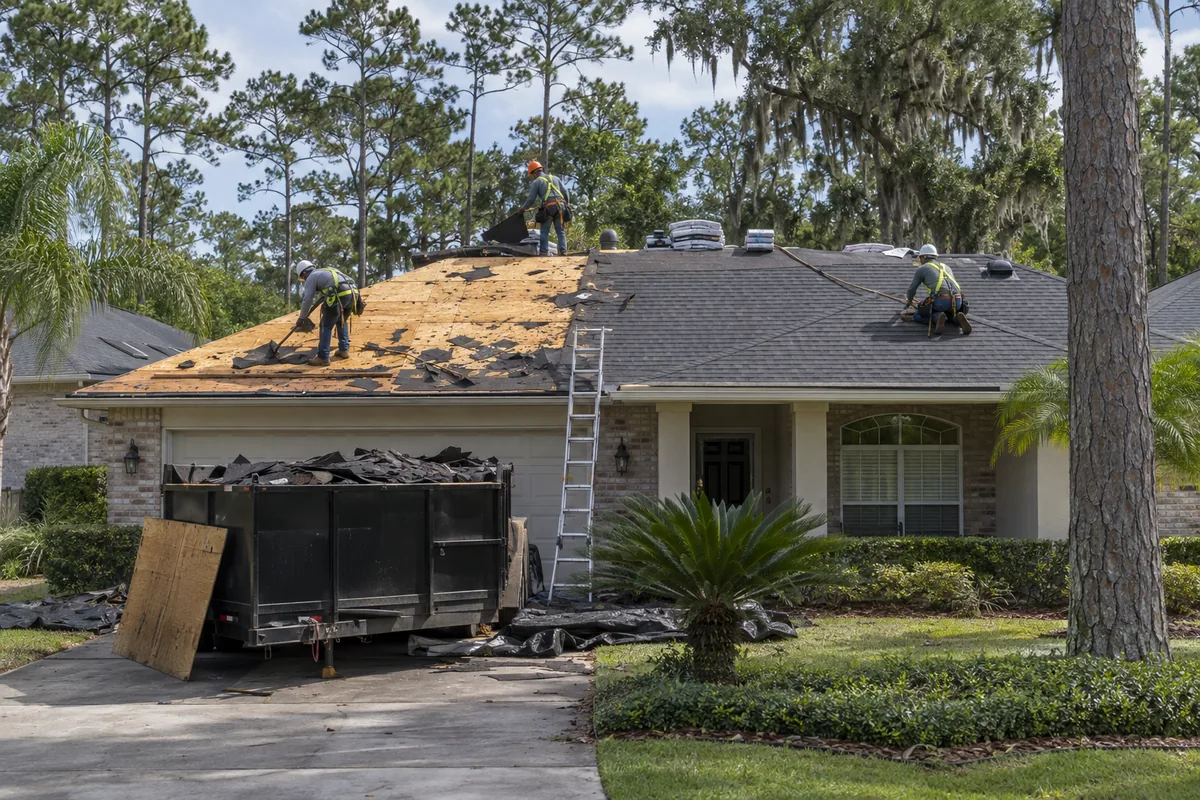
The crew arrives early, because from June through September the goal is to be dried in before the afternoon storm builds over the St. Johns River. A dumpster or dump trailer goes on the driveway, tarps go over the landscaping and the air conditioning condenser, and the old roof comes off in sections. Only as much roof is opened as can be re-covered with underlayment the same day. Rotted wood found during tear-off is shown to you and priced per sheet before it is replaced.
Expect noise from roughly 7 a.m., someone in the attic checking for nails that came through, and a magnet sweep of the yard and driveway at the end of every day. A typical house is dried in on day one and shingled on day two; steep historic roofs in Springfield, tile, and standing seam take longer. Move cars out of the garage before the crew arrives, take pictures and mirrors off the walls under the roof, and keep pets inside.
HOA rules and timeline
In the 2000s-and-later subdivisions of Bartram Park, Nocatee, Oceanway and the St. Johns Town Center area, the HOA architectural committee usually has to approve shingle color and any switch to metal. Send the application when you accept the estimate so the review runs while the permit is processed, and ask the roofer for the product data sheet and color sample the committee wants. Historic districts have their own review for visible changes. From signed estimate to final inspection, plan on a few weeks in most of the year and longer in the months after a named storm, when every roofer in Duval County has a waiting list. Before you sign, verify the CCC license at myfloridalicense.com and read the guide to choosing a roofing company.
What is included
- Roof inspection from the attic and the roof surface before the estimate is written, including decking, ventilation and flashing condition
- Complete tear-off of the old shingles, underlayment and flashing down to the wood deck, with the debris hauled away
- Re-nailing of the existing deck with ring-shank nails and replacement of rotted or delaminated plywood, priced per sheet before it goes in
- Peel-and-stick secondary water barrier or approved synthetic underlayment sealed to the deck per the Florida Building Code
- New metal drip edge at eaves and rakes, new pipe boots, valley metal and step flashing at walls and chimneys
- Architectural, algae-resistant shingles nailed six per shingle, or standing seam metal or tile with Florida Product Approval
- Ridge and soffit ventilation balanced for Jacksonville humidity, with the City of Jacksonville or Beaches permit pulled and inspected
- Photos of every stage and the paperwork you need for a wind mitigation inspection and your insurer
Signs you should call
- 3-tab shingles from the 1990s or early 2000s that are curling, bald or losing granules into the gutters
- Leaks in more than one place, or a leak that came back after two or three repairs
- Your insurer sent a letter about roof age or asked for an inspection to renew the policy
- Wind damage after a storm covers a large share of one slope and the shingles around it are brittle
- The deck feels spongy underfoot or you can see daylight or sagging from the attic
- You are buying or selling a home in Duval County and the 4-point inspection flagged the roof
Do not sign a replacement contract at the door
After a storm, crews from out of state work Jacksonville neighborhoods offering a free roof if you sign a form. In Florida a roofer cannot pay or waive your deductible, and assignment of benefits for roofing has largely been eliminated. Get a written estimate, verify the CCC license at myfloridalicense.com, and call your insurer yourself.
Frequently asked questions
How do I know if my roof needs replacing rather than repairing?
Look at age, spread and the deck. A 3-tab roof from the 1990s in Mandarin or Argyle Forest that is curling on every slope has reached the end of its life, and patching one spot moves the next leak a few feet over. A roof with a single failed pipe boot or one wind-lifted section and otherwise sound shingles is a repair. The roofer checks whether the shingles still seal, whether the mat is brittle, and whether the deck is solid from the attic. The estimate states plainly which it is and why, and if repair is the honest answer, that is what gets written.
Does Florida allow a second layer of shingles instead of a tear-off?
The Florida Building Code allows no more than two layers of asphalt shingles, so an overlay on a single-layer roof is technically permitted in some cases. In practice tear-off is the standard in Jacksonville. An overlay hides rotted decking, cannot include the sealed secondary water barrier that insurers and wind mitigation inspectors look for, adds weight, and shortens the life of the new shingles because they sit on an uneven, hot surface. Most manufacturer warranties are reduced or void on a second layer. If a contractor proposes an overlay, ask what the deck looks like, because they have not seen it.
What is the 25 percent rule and does SB 4-D apply to my roof?
Under older Florida Building Code rules, repairing or replacing more than 25 percent of a roof section within 12 months meant the whole section had to be brought to current code, which often forced a full replacement after moderate storm damage. Senate Bill 4-D, passed in 2022, changed that for roofs built or replaced under the 2007 code or later: those can be repaired regardless of the 25 percent threshold. Whether your roof qualifies depends on its permit date, which the roofer can check against City of Jacksonville records. Ask which rule applies to your roof's age before assuming replacement is required.
Do I need a permit to replace a roof in Jacksonville?
Yes. A re-roof in Duval County requires a permit from the City of Jacksonville Building Inspection Division, and inspections are made during the job, typically at the dry-in stage and at completion. Jacksonville Beach, Atlantic Beach and Neptune Beach run their own building departments, and Ponte Vedra Beach falls under St. Johns County. The licensed roofer pulls the permit in the company's name, which is one reason to avoid anyone who asks you to pull an owner-builder permit. The permit record is also what a wind mitigation inspector and your insurer use to confirm the roof's age and code compliance.
Will a new roof lower my homeowner insurance premium?
Often it helps, but no roofer can promise what an insurer will do. Florida insurers frequently decline or non-renew policies on shingle roofs older than about 15 years, so a new roof removes that problem. After the job, a wind mitigation inspection on Form OIR-B1-1802 documents the roof covering date, deck attachment, sealed secondary water barrier and roof-to-wall connections. Each item can qualify for a discount. Keep the permit, the final inspection record and the roofer's photos of the underlayment, because the inspector needs to verify them. SB 2-D also bars insurers from refusing coverage solely because a roof is under 15 years old.
How long does a roof replacement take and what happens on tear-off day?
A typical single-family home in Jacksonville is torn off and dried in on the first day and finished on the second, with larger or steeper roofs, tile and standing seam metal taking longer. Weather matters: crews start early to beat the afternoon thunderstorms from June to September and will not open more roof than they can dry in before rain. On tear-off day expect a dumpster in the driveway, a crew of several people, noise from about 7 a.m., and nails around the yard until the magnet sweep. Move cars out of the driveway, take fragile items off walls, and cover anything stored in the attic.
My subdivision has an HOA. Does that affect the roof?
In newer communities such as Bartram Park, Oceanway and the developments around eTown, the HOA architectural review committee usually has an approved list of shingle colors, and some require approval before switching from shingles to metal or before a color change. Approval can take a couple of weeks, so start the application when you accept the estimate. The roofer can supply product data sheets and color samples for the submission. Historic districts like Riverside and Avondale have their own review for visible exterior changes on contributing structures. Neither the HOA nor a historic board replaces the City permit; you need both.