
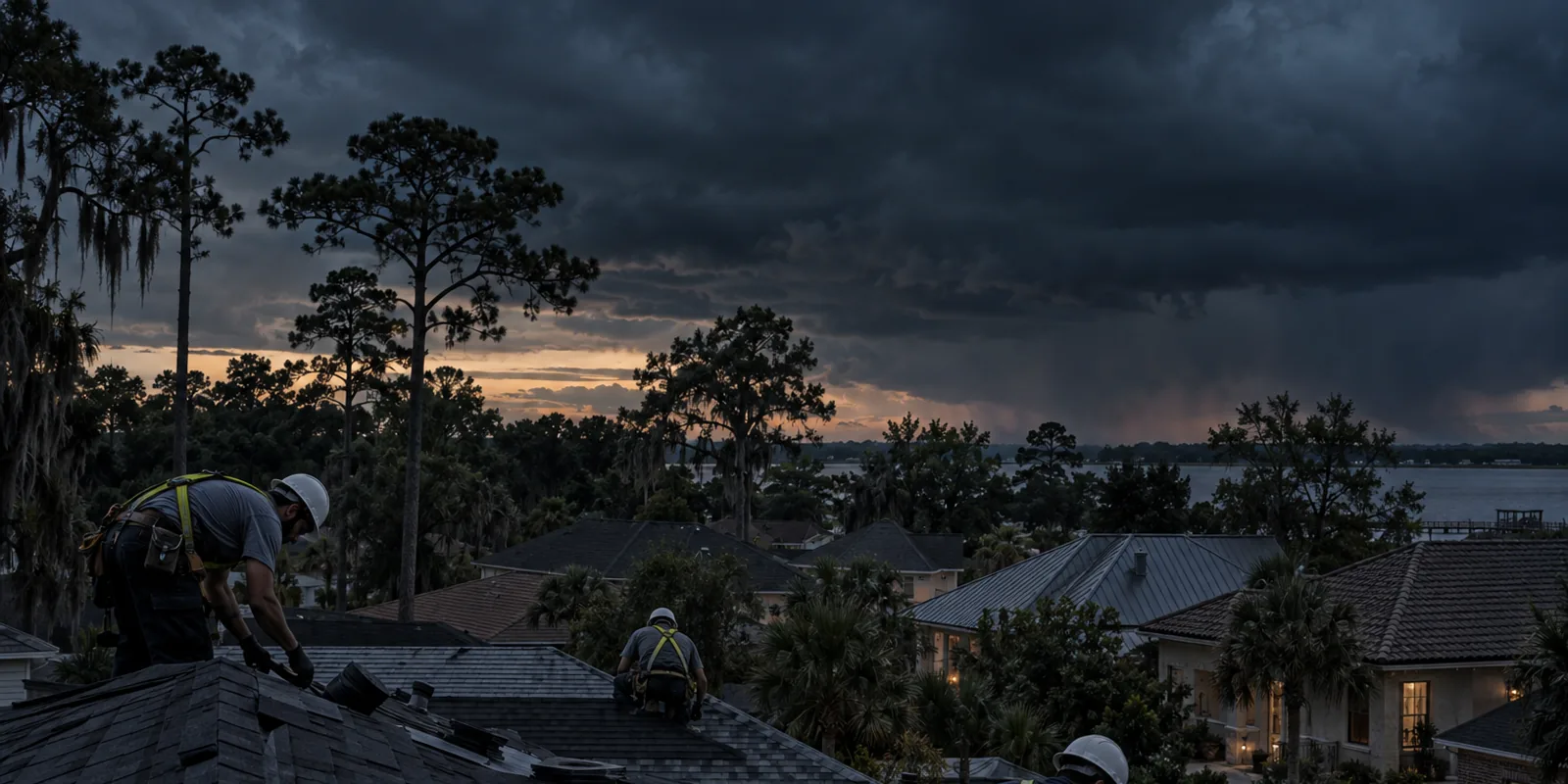
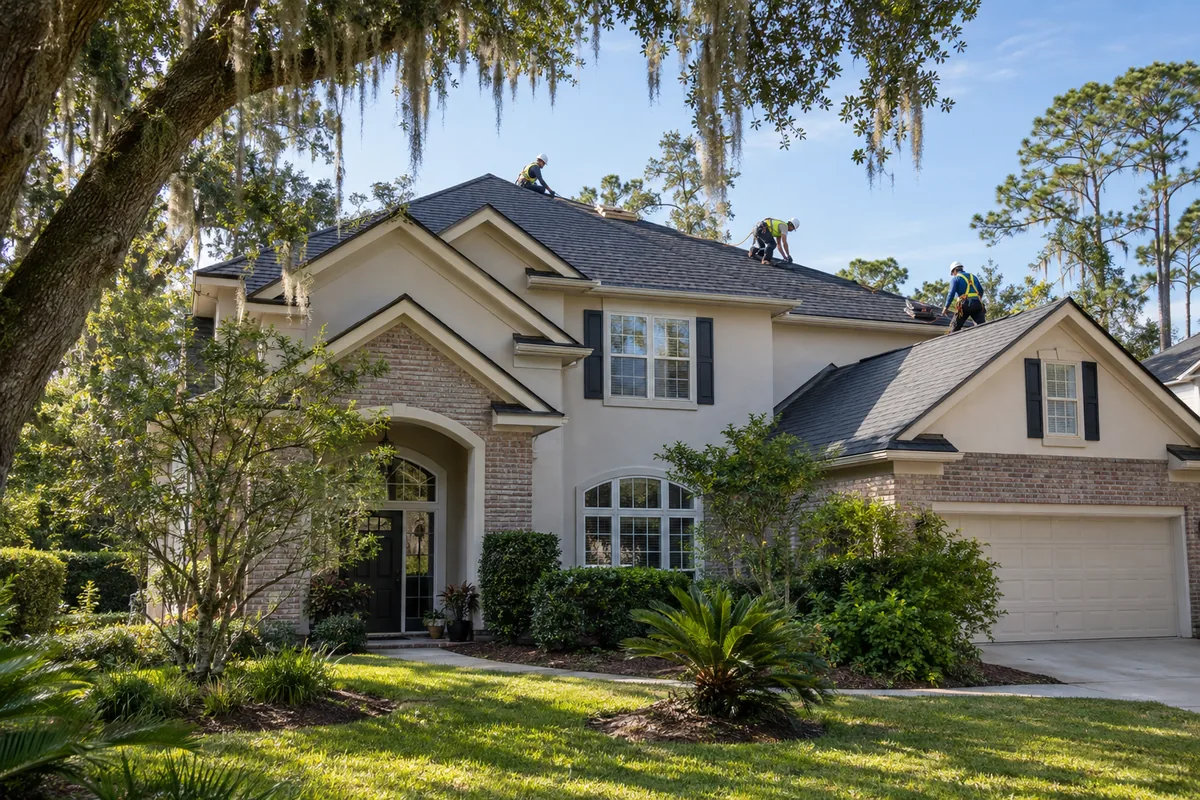
Jacksonville is the largest city by area in the contiguous United States, and its housing stock spans a century. A 1925 bungalow in Riverside, a 1965 ranch in Arlington, a 1992 two-story in Mandarin and a 2018 build in Bartram Park need different things from a roofer, and a residential roofing contractor in Duval County has to know all four. This page lays out the range of home roof work, what each era of Jacksonville house tends to need, how shingles, metal and tile fit different neighborhoods, and how insurance, wind mitigation and 4-point inspections now drive most of the decisions homeowners make about their roofs.
Repair, replace or maintain: the three kinds of home roof work
Residential roofing breaks into three jobs, and the inspection decides which one you need. A repair fixes a specific failure, such as a cracked pipe boot, a lifted course of shingles after a windy night, a slipped tile or a rotted section of fascia, on a roof that otherwise has life left. The roof leak repair page covers how the source is traced before anything is fixed. A replacement is for a roof whose covering has worn out across the board, where patching one spot just moves the next leak, or where an insurer will not renew on its age; the roof replacement page covers the tear-off, code items and permits. Maintenance is the visit in between: gutters and valleys cleared, boots and flashing checked, a few nails resealed, algae treated, and a short report that tells you how many years the roof has left. Most Jacksonville homes need all three at different points, and a roofer who only sells the middle one is not the right roofer.
Jacksonville homes by era and what their roofs need
The historic districts. Riverside, Avondale, Springfield, San Marco, Murray Hill and Ortega were built between the 1900s and 1940s with steep gables, dormers, hips and cross-gables that make for a lot of valleys and flashing. Many carry standing seam or 5V crimp metal, some original, and the rest have shingles over decking that may be tongue-and-groove boards rather than plywood. Work here means matching a metal profile, rebuilding chimney flashing in old brick, and respecting historic district review. The Riverside area page covers those homes in more detail.
The mid-century ranches. Arlington, Cedar Hills, Lake Shore, Southside Estates and Fort Caroline went up in the 1950s through the 1970s: single-story, low-slope hip roofs, wide eaves, original plywood or board decking. These roofs have been re-covered two or three times, and the deck is often the real story. Rot at the eaves from decades of clogged gutters and soft plywood around old vents show up at tear-off. Low slopes also mean wind-driven rain gets under laps more easily. The Arlington area page has more on that housing stock.
The 1980s and 1990s subdivisions. Mandarin, Baymeadows, Deerwood, Argyle Forest and Orange Park were built with 3-tab shingles that commonly last 12 to 18 years in Florida sun, and many are on their second roof already. This is where most of the replacement work in Duval County is happening: whole streets going to architectural shingles within a few years of each other as insurers focus on roof age.
The 2000s and later. Bartram Park, Nocatee, Oceanway, eTown and the St. Johns Town Center area have architectural shingles installed under the modern Florida Building Code, HOA color rules, and roofs now entering the age where pipe boots crack and nail pops start. Repairs dominate here, with the first wave of replacements still a few years off.
The Beaches. Jacksonville Beach, Atlantic Beach, Neptune Beach and Mayport mix 1950s cottages, 1970s and 1980s condos and townhomes, and new coastal builds with standing seam metal. Salt air, nor’easters and onshore wind shape every job there.
Shingles, metal and tile across Duval County
Architectural, algae-resistant asphalt shingles are the default replacement on most Jacksonville homes. They meet the wind rating for this region when nailed six per shingle over a sealed deck, most HOAs approve them, and the black streaks of Gloeocapsa magma that shade and humidity encourage take much longer to appear on the AR versions. Standing seam metal is growing fast at the Beaches, on historic homes and on new builds; it sheds wind-driven rain, lasts far beyond asphalt, and handles salt air when the panels and fasteners are specified for it. The metal roofing page covers profiles and coastal detailing. Concrete and clay tile is the covering of choice in Ponte Vedra Beach, Deerwood, Queen’s Harbour and parts of Mandarin. It lasts decades, but the underlayment beneath it does not, and walking it wrong breaks tiles, which is why the tile roof repair page exists.
Insurance-driven replacements and roof age
For most Jacksonville homeowners today, the decision to replace a roof arrives in an envelope from the insurer, not as a leak. Florida carriers routinely decline to write or renew policies on shingle roofs older than about 15 years, or require an inspection showing five or more years of remaining life, and metal and tile face a similar test at 25 to 30 years. SB 2-D in 2022 bars an insurer from refusing coverage solely because a roof is under 15 years old, and lets an older roof qualify with a favorable inspection. What no roofer can do is promise what a particular carrier will decide. What the roofer can do is inspect honestly, repair what will pass, document the roof’s age and condition, and, when replacement is the only route to coverage, do it to code with the paperwork insurers ask for.
Wind mitigation and 4-point inspections
Two inspections shape residential roofing in Florida. The wind mitigation inspection, on Form OIR-B1-1802, records roof shape, deck nailing, roof-to-wall clips or straps, a sealed secondary water barrier, the covering’s age and permit, and opening protection. Each item can earn a discount, and after a replacement the savings can be significant, so it is worth scheduling as soon as the final inspection clears while the underlayment photos are fresh. The 4-point inspection covers roof, electrical, plumbing and HVAC on homes around 20 years and older when a new policy is written; its roof section records the covering, age, condition and estimated remaining life. A maintenance visit before the inspector arrives, fixing lifted shingles, cracked boots and clogged valleys, frequently changes the result. The maintenance and inspection page covers both.
Storms, humidity and the yearly maintenance visit
Hurricane season runs June 1 to November 30, and afternoon thunderstorms run most of the summer. Wind uplift on ridge caps, rakes and eaves is the most common damage, followed by limbs from live oaks and pines. Between storms, humidity and shade grow algae, moss and lichen, and pine needles pack the valleys. A yearly visit, ideally in late spring before the season, clears the valleys and gutters, checks every boot and flashing, reseals nail pops, and photographs the roof so there is a dated record if a claim is ever filed. After a storm, the roofer separates wind damage from wear in the report, because a claim that mixes the two fails at adjustment and Florida gives only one year from the date of loss to file.
Licensing, permits and choosing a residential roofer
Roofing in Florida requires a Department of Business and Professional Regulation license, and a Certified Roofing Contractor number starting with CCC can be verified at myfloridalicense.com in a minute. Re-roofs and most repairs beyond minor patching need a permit from the City of Jacksonville Building Inspection Division, or from the Beaches cities for homes east of the Intracoastal, and the licensed contractor pulls it in the company name. The estimate is written and itemized, the roof is inspected before it is priced, and anything found during the work is priced before it is done. For a checklist of what else to verify before signing, read the guide to choosing a roofing company, and for what moves the price on a repair versus a replacement, the roof repair cost post explains it without quoting numbers that would not apply to your roof.
What is included
- Roof inspection from the attic and the surface, with a written report on condition, remaining life and what actually needs doing
- Repairs to shingle, metal and tile roofs: boots, flashing, lifted shingles, cracked tiles, fasteners and decking
- Full replacement with tear-off, re-nailed deck, sealed underlayment, drip edge and a covering matched to the house and the HOA
- Historic-home work on steep gables, dormers and standing seam or 5V metal in Riverside, Avondale and Springfield
- Storm damage assessment and photo documentation for insurance claims, separating wind damage from wear
- Wind mitigation inspection paperwork and roof documentation for 4-point inspections and policy renewals
- Annual maintenance visits: gutters and valleys cleared, boots and flashing checked, algae treatment where wanted
- Permits pulled with the City of Jacksonville or the Beaches city and a Florida-licensed contractor on every job
Signs you should call
- You bought or are selling a Jacksonville home and the inspection report flagged the roof
- Your insurer wants a roof inspection, a wind mitigation form or proof of roof age to renew
- The roof is the original 3-tab from a 1990s subdivision and neighbors are all replacing theirs
- Black streaks, moss or lichen are spreading on shaded slopes under oaks or pines
- A ceiling stain, a lifted shingle or a slipped tile appeared after a storm
- You want a yearly check so small problems get fixed before hurricane season
Verify the license before anyone gets on your roof
Roofing without a license is a crime in Florida, and unlicensed work can void your insurance claim and leave you without recourse. Look up the contractor's Certified Roofing Contractor number, which starts with CCC, at myfloridalicense.com, ask for the insurance certificate, and get the estimate in writing before work begins.
Frequently asked questions
Do you handle small repairs or only full roofs?
Both, and the small ones matter. A cracked pipe boot, three lifted shingles after a windy night, a slipped tile or a rusted section of drip edge is a repair, and it is priced as one. Selling a replacement to a homeowner in Mandarin whose roof has ten years left is not a service. The inspection comes first, the report says what the roof needs, and the estimate follows that. Full replacements, storm work, maintenance visits and the inspection paperwork insurers ask for are all part of residential roofing here, from Ortega bungalows to new construction in Oceanway.
What kind of roof does a typical Jacksonville home have?
It depends on when the neighborhood was built. Riverside, Avondale, Springfield, San Marco and Murray Hill homes from the 1900s to 1940s have steep gables, dormers and hips, often with standing seam or 5V metal. Arlington, Cedar Hills, Lake Shore and Southside Estates are 1950s to 1970s ranch homes with low-slope hips and original decking. Mandarin, Baymeadows, Deerwood and Argyle Forest were built in the 1980s and 1990s with 3-tab shingles that are being replaced now. Bartram Park, Oceanway and the Town Center area have 2000s architectural shingles and HOA rules. The Beaches mix 1950s cottages, 1970s condos and new metal-roofed builds.
Should I choose shingles, metal or tile for my Jacksonville home?
Architectural, algae-resistant asphalt shingles are the standard across Duval County: rated for the wind region, approved by most HOAs, and the least expensive to install and repair. Standing seam metal costs more up front, lasts far longer, sheds wind-driven rain well, and suits the Beaches and the historic districts, though it needs coastal-grade panels and fasteners near salt air. Concrete or clay tile is common in Ponte Vedra Beach, Deerwood and parts of Mandarin; it lasts decades but needs a structure sized for the weight and a roofer who can walk it without breaking it. The house style, the HOA, your budget and how long you plan to stay decide it.
What is a wind mitigation inspection and do I need one?
It is an inspection on Florida Form OIR-B1-1802 that documents the features of your roof that reduce hurricane damage: roof shape, how the deck is nailed, how the roof is tied to the walls, whether there is a sealed secondary water barrier, the age and permit of the covering, and window protection. Insurers give discounts for each item, and on a newer roof the savings can be substantial. It is done by a licensed inspector or contractor, usually takes under an hour, and is worth doing right after a replacement, when the paperwork and photos of the underlayment are fresh.
My insurer wants a 4-point inspection. Is that the same thing?
No. A 4-point inspection covers the roof, electrical, plumbing and HVAC of an older home, roughly 20 years or more, when an insurer writes a new policy. The roof portion records the covering type, age, condition and an estimated remaining life. Florida insurers often decline shingle roofs past about 15 years or ask for proof of five or more years left, so a roof in poor shape on the 4-point can hold up the policy. A roofer's repair or maintenance visit before the inspection, fixing lifted shingles and failed boots, often makes the difference. Nothing here promises what any insurer will decide.
Why are all the roofs in my subdivision being replaced at once?
Because they were all installed the same year. Subdivisions in Mandarin, Argyle Forest, Baymeadows and Orange Park went up in the 1980s and 1990s with 3-tab shingles that commonly last 12 to 18 years under Florida sun, and many are on a second roof already. Add insurers' focus on roof age since 2022, and whole streets get new roofs within a few years of each other. If yours is that age, an inspection tells you whether it has time left or whether the insurer letter is coming. Replacing before a storm damages it is usually easier than replacing after.
Does an HOA or historic district affect what I can put on the roof?
Often. Communities built since the 2000s such as Bartram Park, Nocatee and the developments near the St. Johns Town Center usually require architectural review approval for shingle color and any switch to metal, and some only allow approved product lines. Riverside, Avondale and Springfield have historic district review for visible changes on contributing homes, which can affect metal panel profile and color. The roofer supplies the data sheets and samples the committee asks for. The City of Jacksonville permit is separate from either approval, and both are needed before the tear-off starts.