
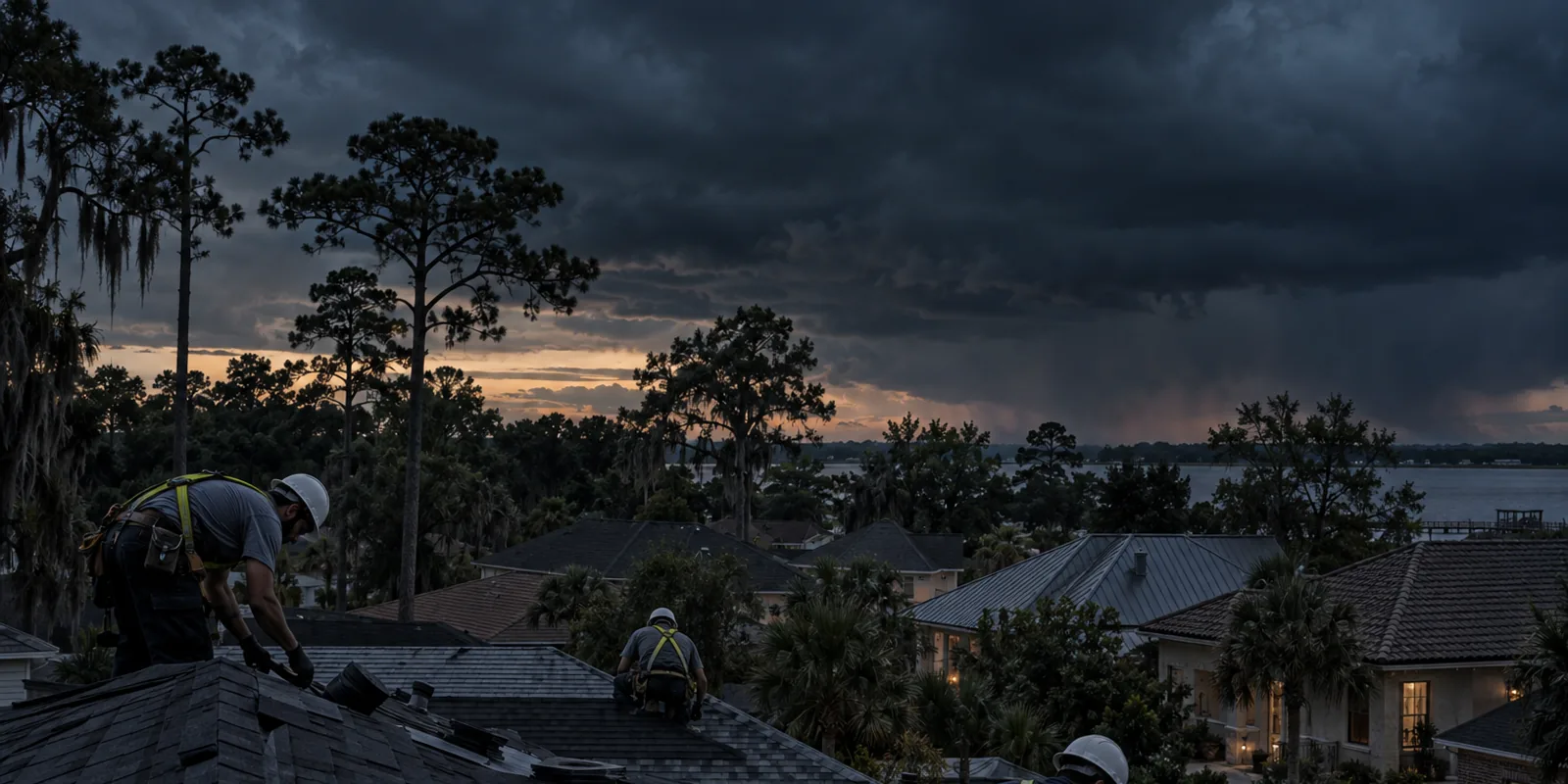
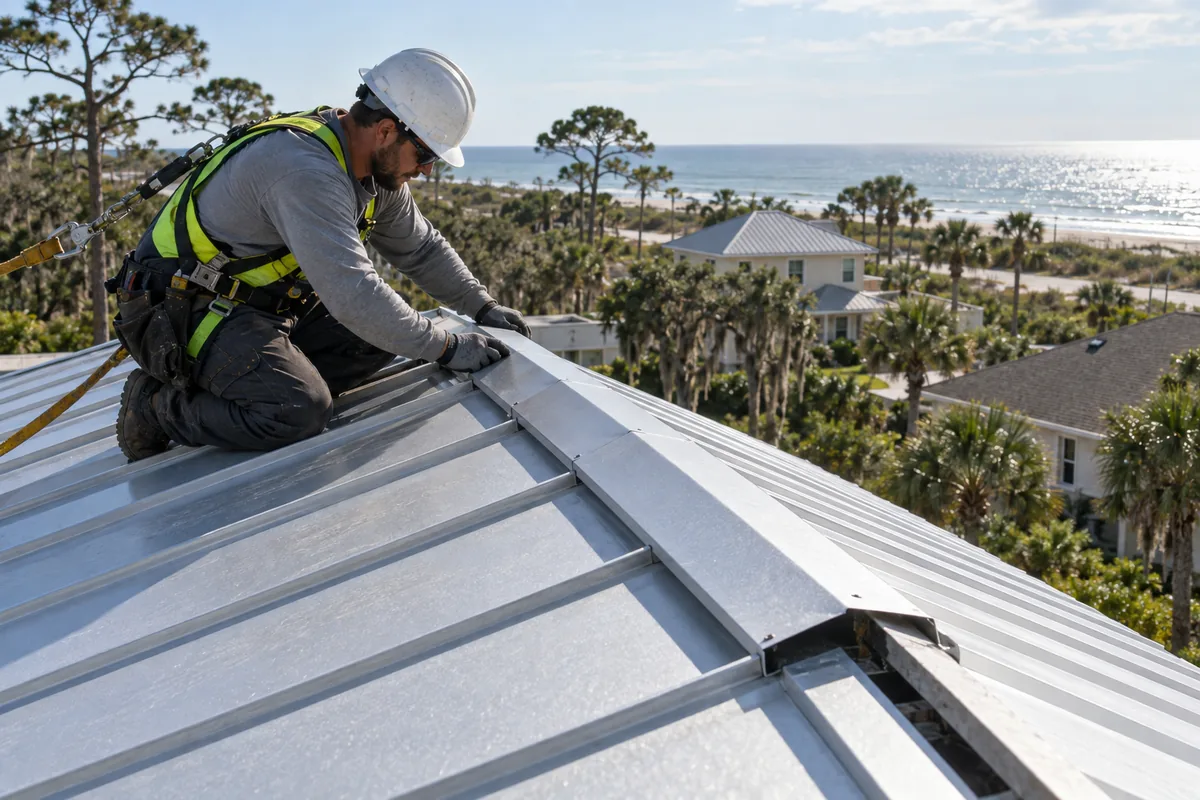
Metal roofing is the fastest-growing roof type in Jacksonville, and it is also one of the oldest. Walk a block in Riverside, Avondale or Springfield and you will see 5V crimp panels that have been on 1920s bungalows for decades; drive Third Street through Neptune Beach and Atlantic Beach and nearly every new coastal build has standing seam. The two types age differently, fail differently and are repaired differently. This page covers both, along with the salt-air corrosion that every metal roof within reach of the Atlantic or the St. Johns River has to deal with, the fastener and washer problems on screw-down roofs, the details at laps, ridges and flashings, when repair stops making sense, and what a new metal roof in Duval County involves.
Standing seam and exposed-fastener roofs across Jacksonville
Standing seam panels run from ridge to eave, lock together at raised seams, and attach to the deck with concealed clips that let the metal expand and contract. There are no screws through the weather surface, which is why standing seam is the choice for new homes at the Beaches, in Nocatee and on the Intracoastal, and why it carries the longest manufacturer warranties.
Exposed-fastener panels, which in Jacksonville usually means 5V crimp on historic homes and ribbed screw-down panels on barns, sheds, additions and older Westside homes, are fixed with screws driven through the panel into the deck or purlins. Each screw has a neoprene or EPDM washer under its head. The panels themselves can last a very long time. The washers do not, and that is the whole story of screw-down metal roof maintenance in Florida.
Knowing which type you have, the gauge, the coating (Galvalume, painted Kynar, galvanized) and the profile determines every repair decision. The roofer confirms this on the first visit and notes it in the report so replacement panels or flashings can be matched.
Salt air and corrosion near the coast
Salt is the enemy of metal roofs from Mayport down through Jacksonville Beach and Ponte Vedra Beach, along the Intracoastal Waterway, and further inland than most people expect along the river through San Marco, Ortega and Riverside. It attacks where the metal is exposed: cut panel ends at the eave, field-cut valleys and hips, scratches from foot traffic or debris, fasteners, and any flashing made from plain galvanized steel. Red rust at a cut edge spreads under the coating. White corrosion on aluminum trim is the same process.
The repair depends on how far it has gone. Surface rust at an edge is cleaned, primed and sealed. A rusted drip edge or valley is cut out and replaced with aluminum or a heavier-coated steel. A panel rusted through is replaced. Near the coast the roofer specifies stainless steel or long-life coated fasteners, aluminum flashings rather than galvanized, and hems on cut edges so the raw steel is not exposed to the spray. The Atlantic Beach area page goes into what the Beaches climate does to every roof type, not just metal.
Fasteners, washers and the screw-down roof
A screw-down roof can have a thousand or more fasteners, and each one is a small hole through the roof sealed by a rubber washer. Jacksonville’s daily heat cycle expands the panel in the afternoon and shrinks it overnight, working each screw in its hole. Over ten to fifteen years the washer hardens, cracks and stops sealing, the hole elongates, and the screw backs out. Water follows the screw shank into the deck, which is why a screw-down roof leak often shows up as a line of small stains on the ceiling along a purlin rather than one obvious drip.
The proper repair is to remove each failed fastener and drive a new, longer, larger-diameter screw with a fresh bonded washer so it bites new wood. Retightening old screws strips the hole and makes the next failure worse. Smearing sealant over every screw head is a temporary measure that cracks in the sun within a couple of summers. On a roof where most fasteners are failing at once, the honest conversation is whether to replace them all, which is a real job, or whether the roof has reached the point where a new standing seam roof over the same deck is the better investment. The roof replacement page covers what that involves.
Oil canning, end laps, ridge closures and flashing
Oil canning, the wavy look across flat panel areas, is cosmetic and not a leak source, though it worries a lot of homeowners after a new install. Leaks on metal roofs come from the details. End laps, where one panel overlaps the next on long runs, must be sealed with butyl tape and fastened through both sheets; when the tape was skipped or has dried out, wind pushes rain up the lap. Side laps on 5V panels leak the same way when the crimp has been flattened by foot traffic.
Ridge and hip caps sit on foam or metal closures shaped to the panel profile. The foam crumbles under UV after enough years, and wind-driven rain from a nor’easter goes straight under the cap. Eave closures fail the same way and also let wasps and rodents in. Replacing closures is a routine repair that stops a surprising number of “mystery” leaks on metal roofs at the Beaches.
Chimneys, walls, skylights and dormers on the historic homes of Riverside and Avondale rely on step flashing, counterflashing and kick-out diverters, and these are frequently done wrong when a metal roof is installed by a crew more used to shingles. Sealant alone is not flashing. The roofer rebuilds the junction with metal that is formed to the panel profile and counterflashed into the wall or chimney.
Repair or replace, and what the code requires
Repairs on a metal roof are worth doing when the panels are sound and the problems are in fasteners, laps, closures and flashings. They are not worth doing when rust has perforated the panels in several places, when the deck underneath is soft from years of screw leaks, or when the roof was laid directly on the old deck with no underlayment, which was common practice on some older Westside and Northside homes and means water that gets past the panel has nowhere to go but inside.
A re-roof in Duval County needs a permit from the City of Jacksonville Building Inspection Division, or the Jacksonville Beach, Atlantic Beach or Neptune Beach building department. The Florida Building Code requires the deck to be renailed to current spacing, a sealed secondary water barrier, and a panel system with a Florida Product Approval for the design wind speed, which along the coast is above 130 mph. Clip spacing and fastener patterns are tighter at the edges and corners of the roof where uplift is highest. The roofer submits the approval with the permit and the city inspects the installation against it.
New metal roofs, wind ratings, insurance and wind mitigation
A new standing seam roof over the existing decking is the most common metal installation in Jacksonville. The old shingles come off, the deck is inspected and renailed, rotted boards at the eaves are replaced, a peel-and-stick or synthetic underlayment goes down, and the panels are installed with clips at the spacing the product approval calls for. Trim, drip edge, valleys and penetration flashings are formed to match, and the ridge gets a vented closure where the attic needs it.
Insurers in Florida look favorably on this kind of roof. A wind mitigation inspection documents the roof covering, its permit date, the deck attachment, the roof-to-wall connection and the secondary water barrier, and carriers apply credits for each feature that meets their criteria. Nothing on this page promises what any insurer will do, but a properly permitted metal roof puts the paperwork in your favor, and the roofer supplies the permit, product approval and photos that the inspection needs. The maintenance and inspection page explains how that inspection works.
If a storm has already damaged your metal roof, lifted panels or torn off ridge caps, the post on hurricane and storm damage insurance claims in Jacksonville walks through documenting the damage, the one-year claim window under Florida law, and why signing anything with a door-knocking crew after a storm is a bad idea.
What is included
- Panel-by-panel inspection of fasteners, washers, seams, end laps, ridge closures and every flashing
- Backed-out screws replaced with oversized, long-life fasteners and new EPDM-bonded washers
- Rust treated or corroded panels, drip edge and flashings replaced with coastal-grade material
- End laps and side laps resealed with butyl tape and sealant rated for metal
- Ridge and hip closures, eave closures and Z-flashing replaced where wind-driven rain gets under the cap
- Chimney, wall and skylight flashings rebuilt with proper counterflashing and kick-outs
- New standing seam or 5V crimp roofs installed over synthetic underlayment with Florida Product Approvals
- Photos and a written report for insurance claims and wind mitigation documentation
Signs you should call
- Screw heads standing proud of the panel, or rust rings spreading around each fastener
- Rust streaks running down panels, at cut edges, or on drip edge and valleys near the coast
- A leak that shows up in nor'easter weather but not in an ordinary afternoon storm
- Panels that rattle, lift or hum in wind, which usually means loose clips or fasteners
- Daylight visible at the ridge or eaves where foam closures have crumbled
- Water stains on the ceiling below a chimney, wall junction or skylight on a metal roof
- A metal roof that is more than 20 years old and has never had its fasteners checked
A metal roof is not the place to learn to walk a roof
Metal panels are slick when wet, hot enough to burn skin on a July afternoon, and can dent or crease if stepped on in the wrong spot. Screw-down panels flex between purlins. If you see a leak or a loose panel, take a photo from the ground and stay off the roof. The roofer will walk it in soft-soled boots along the fastener lines and tarp any open area if a storm is coming.
Frequently asked questions
What is the difference between standing seam and 5V crimp metal roofing?
Standing seam panels lock together at raised vertical seams and are fastened to the deck with hidden clips, so no screw penetrates the surface. That makes them the longest-lasting metal option and the one usually chosen for new coastal homes. 5V crimp and other exposed-fastener panels are screwed straight through the metal into the deck or purlins, with a rubber washer under each screw head. They cost less and suit the historic look on Riverside, Avondale and Springfield homes, but every one of those screws is a future maintenance point as the washers age in the Florida sun.
Why do the screws on my metal roof keep backing out?
Metal expands in the afternoon heat and contracts overnight, and on a screw-down roof that movement works each fastener a little every day. Over years the hole widens, the screw loosens and the washer beneath it dries, cracks and stops sealing. Rain then follows the screw into the deck. The repair is not to retighten the old screws, which strips the holes further, but to replace them with a longer, larger-diameter fastener and a new washer that bites fresh wood. On a roof with hundreds of failing screws the roofer will discuss whether the panels have enough life left to justify it.
Does salt air really damage a metal roof in Jacksonville?
Yes, within a few miles of the ocean and along the Intracoastal Waterway and the St. Johns River. Salt spray settles on the roof and attacks cut panel edges, fasteners, drip edge and any spot where the factory coating has been scratched. Galvalume and painted steel panels resist it for a long time if the edges are protected and the roof is rinsed by rain; unpainted galvanized steel and cheaper fasteners do not. At Jacksonville Beach, Atlantic Beach, Neptune Beach and Mayport, the roofer specifies stainless or coated fasteners and aluminum flashings, and checks cut edges and valleys on every inspection.
What is oil canning and is it a defect?
Oil canning is the wavy, rippled look you sometimes see in the flat part of a standing seam panel, especially in low afternoon light. It is caused by stresses in the metal from the rolling process, thermal movement, or an uneven deck beneath, and it is cosmetic. It does not cause leaks and manufacturers exclude it from warranty. It can be minimized on a new roof with striations or ribs in the panel, a thicker gauge, and a flat, well-fastened deck. On an existing roof there is no practical repair for it, and no roofer should sell you one.
Can a metal roof be repaired instead of replaced?
Most of the time. Fastener and washer replacement, resealing end laps, replacing rusted flashings and renewing ridge closures are routine repairs that extend a metal roof for years. Individual damaged panels can be swapped if the profile is still made. Replacement becomes the better path when rust has gone through the panels in multiple places, when a screw-down roof has so many failed fasteners that the deck beneath is soft, or when the panels were installed without underlayment on an older home and every rain finds a new way in. The written estimate spells out both routes.
Do I need a permit and a Florida Product Approval for a new metal roof?
A new metal roof or a re-roof in Duval County needs a permit from the City of Jacksonville, or from the Beaches city building department where applicable, and the panel system must carry a Florida Product Approval showing it meets the design wind speed for the location. Jacksonville's coastal areas fall in the wind-borne debris region with design speeds above 130 mph, so the approval, the clip spacing and the fastener pattern all matter. The roofer submits the approval number with the permit and the inspector checks the installation against it. Ask to see the approval before signing.
Will a metal roof lower my homeowners insurance in Florida?
It often helps, but no roofer can promise what an insurer will do. A metal roof installed to current Florida Building Code, with the deck renailed, a sealed secondary water barrier and roof-to-wall straps documented, scores well on the wind mitigation inspection form, and insurers apply credits for those features. Insurers also tend to accept a metal roof at an age where they would refuse a shingle roof. After a new installation the roofer provides the permit, the product approval and photos so a wind mitigation inspection can be completed and sent to your carrier.