
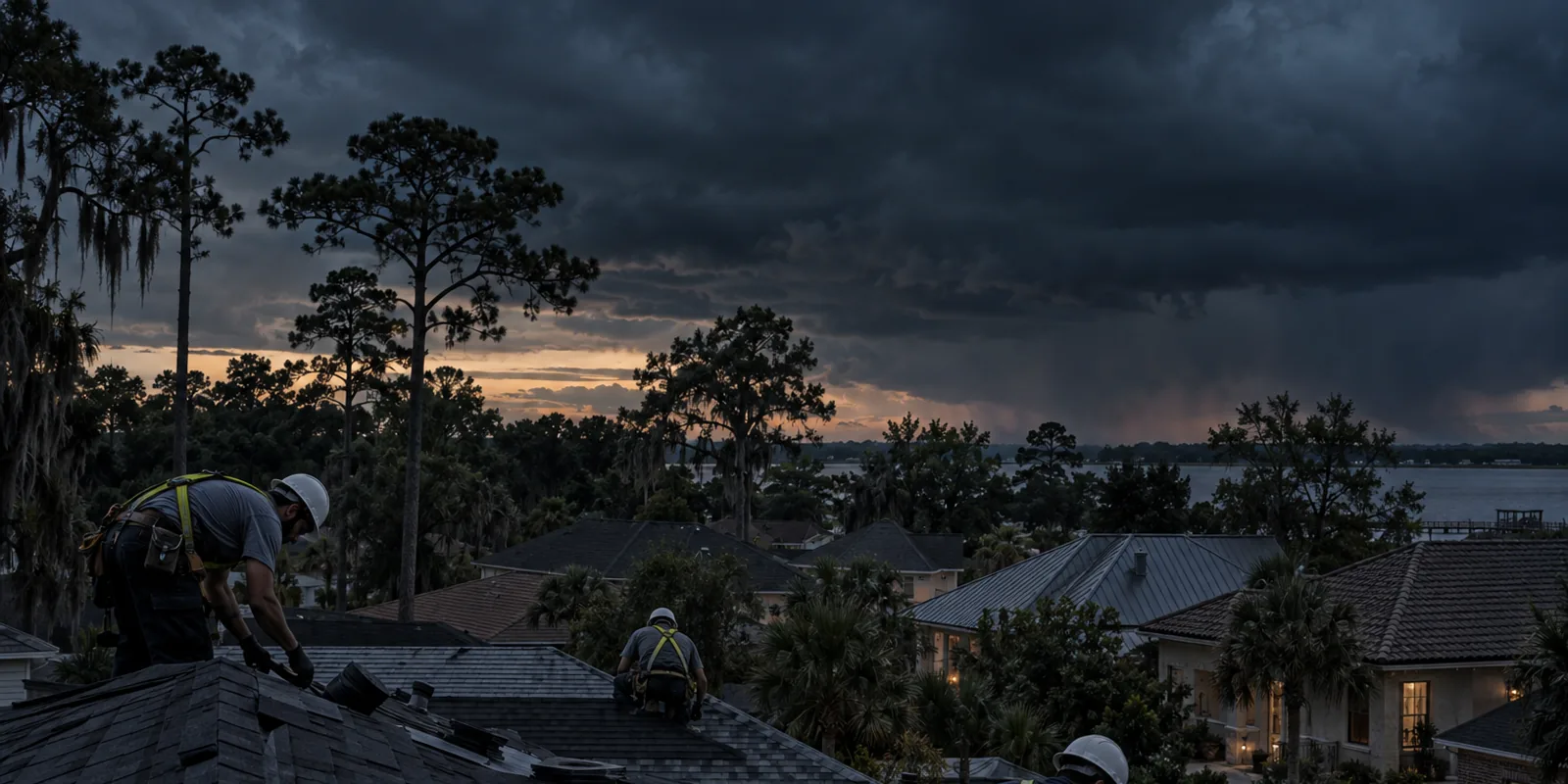
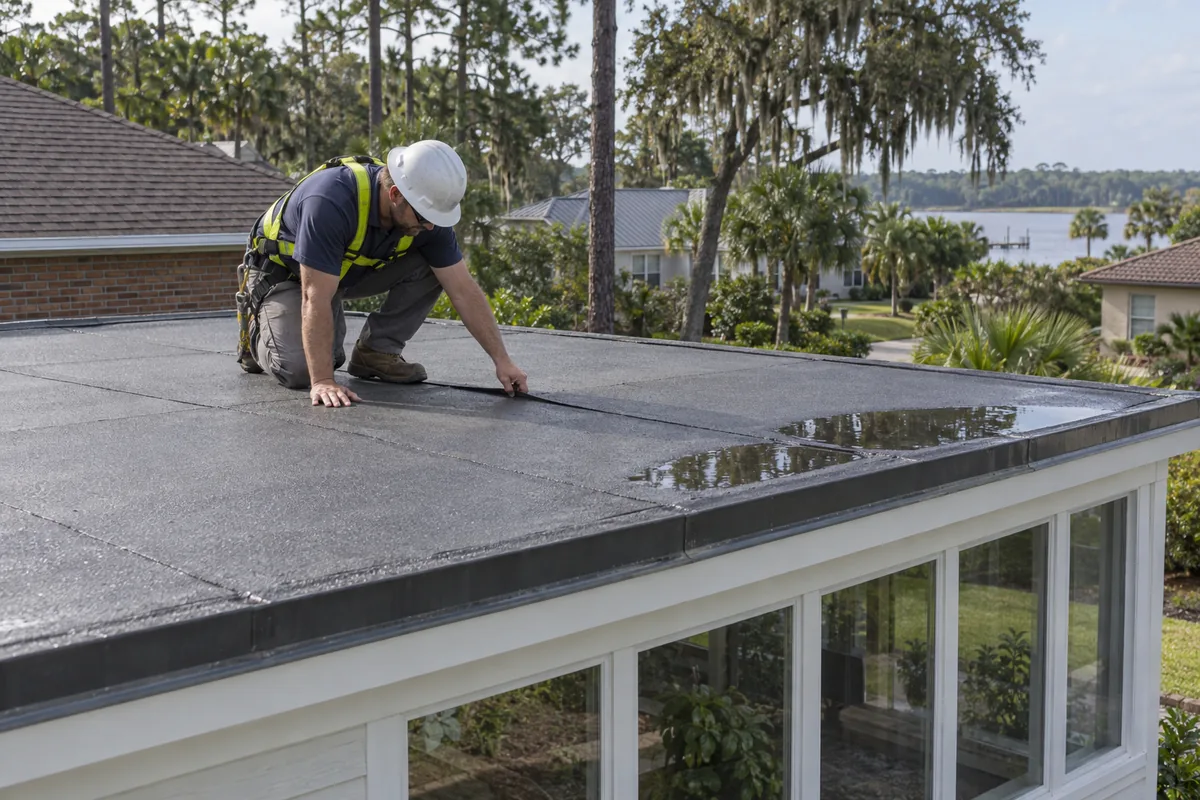
A flat roof in Jacksonville is never truly flat, and when it is, that is the problem. Low-slope roofs on porch additions, Florida rooms, carports and mid-century homes in Arlington and Southside Estates, and on the office parks and strip centers along Beach Blvd, Atlantic Blvd and Blanding Blvd, all rely on a membrane, positive drainage and good flashing to survive more than 50 inches of rain a year. This page explains the low-slope systems common in Duval County, why ponding after an afternoon storm matters, where membranes fail, how drains, scuppers, parapets and HVAC curbs are repaired, and how to decide between a coating, a re-cover and a full replacement.
Low-slope roofs on Jacksonville homes and businesses
Residential low-slope sections are common across the older parts of the city. Ranch homes built from the 1950s through the 1970s in Arlington, Fort Caroline, Lake Shore and Southside Estates often have a flat or nearly flat section over a converted carport, a screened porch that became a Florida room, or an addition tied into the main hip roof. Many of these started life as built-up roofs with gravel and have since been patched with roll roofing, aluminum coating, or whatever the previous owner had in the garage. On newer homes in Mandarin and Baymeadows, a flat section over a lanai or a garage bump-out is usually modified bitumen or a small TPO membrane.
Commercial low-slope roofs make up the larger share of the work. Southside office parks near Baymeadows Rd and Southside Blvd, strip centers, restaurants, churches, warehouses on the Westside near NAS Jacksonville and on the Northside near the airport are mostly single-ply TPO or EPDM, modified bitumen, or older built-up roofs with a gravel surface. Each system fails in its own way. TPO fails at heat-welded seams and around penetrations. EPDM fails at glued seams and where the rubber has shrunk and pulled away at the perimeter. Modified bitumen fails at end laps and where the granule surface has worn through. Built-up roofs blister, alligator and open up at the flashings. A repair begins with identifying what is actually up there, which is not always obvious after several rounds of patching.
Ponding after the afternoon storm
Between June and September Jacksonville gets an afternoon thunderstorm most days, and a low-slope roof has to move an inch of rain in half an hour and then dry out before the next one arrives. Ponding is standing water that remains more than 48 hours after the rain stops. A little water at a drain that dries by the next morning is normal. A puddle that is still there two days later is a different matter. It adds weight, the deck deflects further under it, the pond grows, and the constant wet-dry cycling in the Florida sun breaks down TPO plasticizers, oxidizes asphalt and lifts seams that would have held on a dry roof. Ponding also grows algae, and algae holds moisture against the membrane.
Ponding is usually a structural or drainage problem, not a membrane problem. The usual causes on Jacksonville roofs are sagging decking between joists on older homes, a drain or scupper set higher than the true low point, a crushed or clogged drain line, an HVAC unit sitting on a curb in the path of the water, or an addition tied in with no slope at all. The fix follows the cause: a new drain or scupper at the low point, tapered insulation crickets to redirect water, or, when the deck is soft, replacing the decking and re-sloping it. Coating over a ponding area without solving the drainage only postpones the leak.
Seams, blisters and punctures
Seams are where most single-ply membranes leak. On TPO, a weld that was run too cold or too fast during installation, or one that has been stressed by building movement, opens along its edge. The repair is to probe every seam in the area and run a new heat-welded cover strip over any that fail. On EPDM, older tape or glue seams let go after years of heat, and the rubber itself can shrink enough to pull the perimeter off the wall. Modified bitumen end laps that were not fully heated lift at the corners and let water under the cap sheet.
Blisters are pockets of trapped air or moisture between plies, and they are common on built-up and modified bitumen roofs here because the roofs are installed in humid weather over decks that were not completely dry. A small, unbroken blister can be left alone and watched. A blister that has cracked open has to be cut out and patched with new plies. Punctures come from dropped tools, HVAC technicians, fallen limbs from live oaks and pines, and the occasional spring hailstorm. Every puncture needs a proper patch rather than a bead of caulk, and the insulation beneath it should be checked for saturation.
Drains, scuppers, parapets and HVAC curbs
Water has to leave the roof somewhere, and the details where it leaves are the details that fail. Interior drains clog with pine needles, live oak leaves and plastic bags that blow up from the road. A clogged drain in July can put several inches of water on a roof within an hour. Strainers are cleaned or replaced, the drain bowl is reflashed if the membrane has pulled away from the clamping ring, and the line is checked for a blockage below the roof. Scuppers through parapet walls rust out at the bottom, and the flashing around them cracks where the membrane turns down into the metal.
Parapet walls and roof-to-wall transitions on strip centers and older homes are a frequent leak source that gets blamed on the field of the roof. The membrane has to run up the wall, be terminated with a bar or counterflashing, and be capped. When the cap flashing rusts near the coast or the termination bar sealant fails, water runs down behind the membrane and into the building. HVAC curbs tell the same story: the membrane must be flashed up the curb, and the unit’s own pan and condensate line must not discharge onto the roof. Pipe and conduit penetrations get pitch pockets that dry out and crack under Florida sun; they are refilled or replaced with a proper boot.
Coating, re-cover or replacement
Once the leaks are found there are three paths. An elastomeric or silicone coating restores a roof that is structurally sound, dry underneath and simply aged on the surface. It reflects heat, which matters on a Jacksonville summer afternoon, and it can add years to a modified bitumen or single-ply roof. A coating is not a repair for a roof with wet insulation, open seams or ponding; the coating fails wherever the roof fails.
A re-cover installs a new membrane over the existing roof, usually with a cover board between them. The Florida Building Code allows one re-cover over one existing roof, so if there are already two layers, or if the existing roof is wet, the roof comes off. A moisture survey or core cuts settle that question before anything is priced. A full replacement removes everything to the deck, replaces rotted decking, installs new insulation with proper slope to the drains, and a new membrane with new flashings. It costs more, but it also resets the roof’s age for your insurer and comes with a manufacturer warranty when installed by a certified contractor.
The roofer’s job is to lay out which path fits the roof in front of you, in writing, with the reasons. The post on what drives roof repair cost in Jacksonville explains what moves the number without quoting dollars.
Permits, inspections and what to expect
A flat roof re-cover or replacement in Duval County needs a permit from the City of Jacksonville Building Inspection Division, or from the Beaches city building department if the building is in Jacksonville Beach, Atlantic Beach or Neptune Beach. Minor patching does not. The roofer pulls the permit under a Florida DBPR Certified Roofing Contractor license, schedules the inspections and closes the permit out; an open roof permit is a real headache when a building changes hands. Products must carry a Florida Product Approval for the wind zone. Work starts with a roof inspection, followed by a written, itemized estimate, and any wet insulation or rotted deck discovered once the roof is opened is priced before it is replaced.
For a leak that is active right now, the roof leak repair page covers tarping and dry-in. For a larger building with several roof sections, the commercial roofing page covers maintenance programs and phased replacements. And the Arlington area page covers the mid-century neighborhoods where residential flat sections are most common.
What is included
- Inspection of the full membrane, every seam, drain, scupper, parapet and rooftop penetration, with a moisture check of the insulation
- Heat-welded cover strips on failed TPO seams and new tape or adhesive seams on EPDM
- Blisters, splits and punctures cut out and patched with matching membrane or plies
- Drain bowls, strainers and scuppers cleared, reflashed or replaced so water leaves the roof
- Parapet, roof-to-wall and HVAC curb flashing renewed with new termination bars and counterflashing
- Tapered insulation crickets or added drains where ponding is caused by poor slope
- Elastomeric or silicone coating when the roof is sound and dry underneath
- Written report with photos, plus permit filing with the City of Jacksonville when the work requires one
Signs you should call
- Standing water still on the roof two days after the last afternoon storm
- A ceiling stain under a porch addition, Florida room, carport or flat commercial section that grows with each rain
- Seams on a TPO or EPDM roof that lift at the edge or show a dark line of moisture
- Blisters, cracks or alligatoring on a modified bitumen or built-up roof
- Water pouring over a parapet or backing up at a drain during heavy rain
- Leaks that started after an HVAC unit was replaced or serviced on the roof
- A soft or spongy spot when the roof is walked, which usually means wet insulation
Do not walk a flat roof that is holding water
A ponding area can hide a soft, saturated deck that will not hold your weight, and a wet membrane is as slick as ice. If water is coming in, put a bucket under the drip, move anything valuable, and stay off the roof. The roofer will check the deck from above and below before anyone stands on it. Photograph the ceiling damage before it is cleaned up if you plan to file a claim.
Frequently asked questions
How do I know if my flat roof is ponding or just draining slowly?
The rule of thumb used across the roofing industry is 48 hours. Water that remains on the roof two days after the rain stops is ponding. Water that dries by the next morning after a normal Jacksonville afternoon storm is not a problem. Ponding shows itself with a ring of dirt, algae or dried sediment around the low spot, and often a slight sag in the deck. It is worth taking a photo of the roof a couple of days after a storm so the roofer can see where the water sits and trace the cause to a drain, a low deck or a missing slope.
Can a flat roof be repaired, or does it have to be replaced?
Most flat roof leaks are local: a failed seam, a cracked pitch pocket, a rusted scupper, a puncture from a dropped tool. Those are repaired. The roof needs replacing when the insulation is wet across a large area, when there are already two roof layers so a re-cover is not permitted under the Florida Building Code, or when seams are failing everywhere rather than in one spot. A moisture survey or a few core cuts answer the question, and the written estimate lays out the repair option and the replacement option side by side.
Will a roof coating stop my flat roof from leaking?
Only if the roof is already sound. Silicone and acrylic coatings restore a dry, well-drained roof by adding a reflective, seamless surface that slows down UV aging in the Florida sun. They do not bridge open seams, cure wet insulation or fix ponding. A coating applied over those problems fails at exactly the same spots. The correct order is to repair the seams and drainage first, confirm the insulation is dry, and then coat. When that order is followed a coating can add years to a modified bitumen or single-ply roof.
What flat roofing material works best in Jacksonville?
White TPO is the most common choice on commercial roofs here because it reflects heat, handles the afternoon storms well when the seams are welded properly, and carries Florida Product Approvals for the wind zone. Modified bitumen suits small residential sections over porches and additions because it tolerates foot traffic and is easy to repair. EPDM is durable but absorbs heat, and its glued seams need more attention in humid weather. Built-up gravel roofs are rarely installed new. The right answer depends on the deck, the slope, the equipment on the roof and how the roof will be used.
Do I need a permit for flat roof repair in Jacksonville?
Minor patching of a seam or a puncture does not require a permit. A re-cover, a full replacement, replacing rotted decking or changing the drainage does, and the permit comes from the City of Jacksonville Building Inspection Division for anywhere in Duval County outside the Beaches cities. Jacksonville Beach, Atlantic Beach and Neptune Beach have their own building departments. The roofer pulls the permit under their Florida DBPR license, schedules the inspections and closes it, which matters later because an open roof permit can hold up a sale or a refinance.
Why does my flat roof only leak in heavy afternoon storms?
A light rain drains away before the water rises high enough to reach a weak spot. A summer downpour puts an inch of water on the roof in thirty minutes, and if a drain is slow or a scupper is partly blocked, the water level climbs above a seam edge, a termination bar or the base of an HVAC curb that is fine in dry weather. Wind adds to it by pushing water up under laps. That is why the inspection looks at how the roof drains under load, not just at the membrane, and why drain clearing is part of most flat roof repairs.
How long does a flat roof last in Florida?
Less time than the same roof would last in a cooler, drier climate. UV exposure, daily heat cycling and constant humidity age every membrane faster, and ponding shortens the life further. A well-installed TPO or modified bitumen roof with clear drains and regular maintenance can reach the upper end of its rated life; a neglected one with clogged drains and standing water can fail much earlier. Annual inspections and drain cleaning before hurricane season are the cheapest way to get the full life out of a low-slope roof in Duval County.