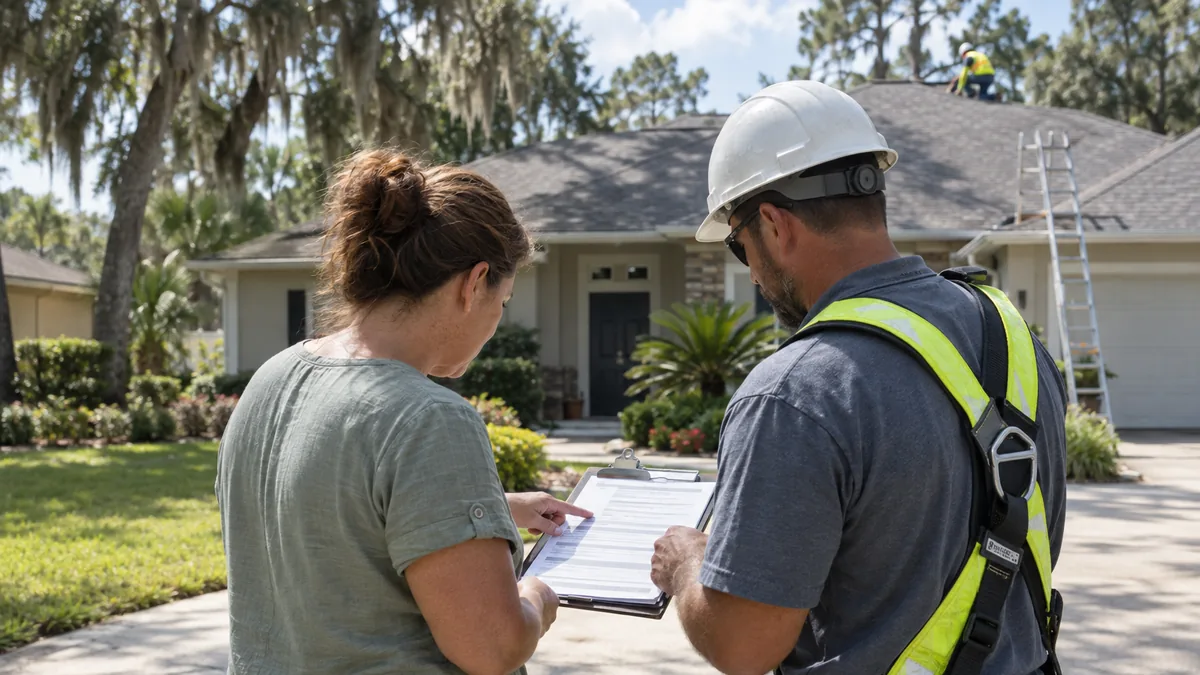
Search for the cost of a roof repair in Jacksonville and you will land on the same thing over and over: a forum thread where someone posts a photo of a ceiling stain, asks what a leak fix should run, and gets a dozen replies that disagree by a wide margin. Nobody in that thread is necessarily wrong. They are describing different roofs. This article does not hand you a number either, because a number given without an inspection is a guess. What it does instead is walk through every factor that decides what a repair costs in Duval County, so that when three estimates land on your kitchen table you can see why they differ and which one is fair.
Why nobody can price a repair before seeing the roof
A roof leak is a symptom, not a diagnosis. Water shows up on a bedroom ceiling in Mandarin, but the entry point may be a cracked pipe boot six feet uphill, a wind-lifted shingle on the northeast slope, or a rusted piece of step flashing where the roof meets a second-story wall. Each of those is a different repair with a different amount of labor and material. The stain tells you there is a problem. It does not tell you which one, and water often travels a long way along the underlayment before it finds a way through.
That is why the process described on this site starts with an inspection and a written, itemized estimate before anything is priced, and why any figure quoted over the phone should be treated as a placeholder. A roofer who commits to a firm price from a description is either guessing high to protect himself or guessing low to get in the door and revising later. Neither serves you.
The pricing page explains how estimates are put together here. The rest of this post explains what goes into them.
The type of repair is the biggest factor
Repairs in Jacksonville fall into a handful of recurring types, and each sits in a different band of effort.
Pipe boot replacement. The neoprene collar around a plumbing vent cracks in the Florida sun after roughly a decade, and it is the single most common leak source on local homes. The fix is a new boot, sometimes a few surrounding shingles, and sealant. Short job, minimal material, one trip up the ladder.
A few wind-lifted shingles or ridge caps. After an afternoon thunderstorm, or a nor’easter that sits over the Beaches for three days, a strip of shingles along a rake or eave or a run of ridge caps is creased or torn. Replacing them is straightforward if the shingle can be matched and the neighbors are still pliable enough to lift without breaking. On a brittle 3-tab roof from the 1990s, every shingle you lift risks cracking the one beside it, and the repair area grows. The shingle roof repair page covers what that looks like in practice.
Valley repair. Valleys carry more water than any other part of the roof, and under live oaks and pines they fill with needles that hold moisture against the shingles for weeks. Repairing one means removing shingles on both sides, replacing the underlayment or valley metal, and cutting new shingles back in. More labor, more material, and more care to get the water path right.
Flashing. Chimney, skylight, roof-to-wall and step flashing. Within a few miles of the ocean and along the St. Johns River, salt air rusts galvanized flashing years before the shingles around it wear out. Reflashing involves lifting siding or counter-flashing, cutting and bending new metal, and sealing it correctly. It is skilled work that takes time, and a shortcut here is a leak next year.
Decking replacement. When a leak has run for months, the plywood or plank decking under the shingles rots. That section has to be cut out and replaced before anything goes back on top, and the Florida Building Code has specific fastening requirements for new decking. You do not know how much is rotten until the shingles come off, which is why a good estimate prices decking as a separate line with a per-sheet rate, rather than a surprise on the final invoice.
Emergency tarping. When water is coming in during a storm, the first visit is a dry-in, not a repair. The tarp or peel-and-stick patch is priced as its own small job and the permanent repair is estimated afterwards, in daylight. The emergency roof repair page explains how that first visit works.
Roof type, pitch, height and access
The same leak costs more to fix on some roofs than on others, and the difference has nothing to do with the leak.
Material. Architectural shingles are the fastest to repair and the easiest to source. Concrete and clay tile, common in Ponte Vedra Beach and on estate homes in Deerwood and Queen’s Harbour, take longer because tiles have to be lifted without cracking, the underlayment beneath them repaired, and matching tiles found, sometimes from a salvage yard. Standing seam metal needs a roofer who knows the panel system, because a clumsy repair on metal is simply a new leak. Low-slope TPO, modified bitumen and built-up sections on porch additions and on commercial buildings along Beach Boulevard need their own materials and techniques. The tile, metal and flat roof pages go into detail on each.
Pitch. A steep roof on a historic home in Riverside or Springfield, with gables, dormers and a hip or two, is slower to work on and requires fall protection and staging that a low-slope 1960s ranch in Arlington or Cedar Hills does not. Past a certain pitch the roof cannot be walked at all and every task takes longer.
Height and stories. Two-story homes in Bartram Park and three-story townhomes near the St. Johns Town Center need longer ladders, more setup time, and sometimes a lift. The repair itself may be identical to one on a single-story home. The time it takes to reach it is not.
Access. A roof hemmed in by a screened pool enclosure, a privacy fence, mature trees or a narrow lot takes longer to stage and clean up, because debris has to be carried out rather than dropped.
Matching materials
A repair only looks like a repair when the new material does not match the old. Shingle colors are discontinued regularly, and a ten-year-old roof that has faded under the Florida sun will not match a fresh bundle of the same product even when it is still made. A good roofer will tell you up front when a perfect match is not possible and offer options: a close match on a back slope where it will not be seen, moving a few shingles from a hidden area to the visible one and putting the mismatch out of sight, or accepting a visible patch on a roof that is a few years from replacement anyway.
Tile is harder. Discontinued profiles have to be sourced secondhand, and the estimate should say where they are coming from. On metal, the panel profile, gauge, color and finish all have to line up or the repair will neither seal nor look right. Any of these can add time to the job before a tool touches the roof.
Permits, the 25% rule and Senate Bill 4-D
In Jacksonville, minor repairs such as a pipe boot or a handful of shingles generally do not need a permit, while structural work, decking replacement and anything approaching a section re-roof do. Permits go through the City of Jacksonville Building Inspection Division for most of Duval County, and through the city building departments in Jacksonville Beach, Atlantic Beach and Neptune Beach. A permit adds a fee and at least one inspection, and a legitimate estimate lists it as a line item rather than hiding it or quietly skipping it.
The rule that surprises homeowners is the 25% rule. Under older Florida Building Code provisions, if more than a quarter of a roof section was repaired or replaced within a twelve-month period, the whole section had to be brought up to current code, which in practice often meant a full replacement. Senate Bill 4-D, passed in 2022, changed that for roofs built or replaced to the 2007 code or later: those roofs can be repaired regardless of the 25% threshold. Roofs older than that may still be subject to the original rule. Which one applies depends on when your roof was last permitted, so ask the roofer directly, and ask to see the permit history if there is any doubt. On the same roof, this can be the difference between a repair estimate and a replacement estimate.
When insurance is involved
If the damage is from wind, hail or a fallen limb, your homeowner policy may cover it, and that changes how the estimate is used rather than what the repair costs. The insurer will want photos, a report stating the cause, and an itemized estimate. The storm damage and insurance claim guide walks through that process from the first hour to the adjuster’s visit.
Two Florida rules matter for cost. First, your deductible is yours. Florida statute 489.147 makes it illegal for a contractor to pay, waive, rebate or absorb a homeowner’s deductible, and any roofer who offers to is proposing insurance fraud with your name on the claim. Second, wear and tear is not covered. A roofer who tells you a fifteen-year-old roof with cracked pipe boots and algae streaks is storm damage is setting up a denied claim.
If the claim is denied, or the damage comes in below your deductible, you are paying out of pocket, and the financing options post explains the general landscape without recommending any lender.
Why estimates differ, and how to read an itemized one
Three roofers look at the same roof in Baymeadows and come back with three different figures. The common reasons:
- One found more damage than the others, or looked in the attic when the others did not.
- One priced the repair, another priced the repair plus preventive work on adjacent areas, and a third priced a section replacement because of the 25% rule.
- Different assumptions about decking: one included a per-sheet allowance, another intends to bill it later.
- Different overhead: a licensed, insured company with workers’ compensation coverage costs more to run than a truck with a ladder.
- Permit included, or omitted.
To compare them, you need each estimate itemized. Look for:
- Scope. What exactly is being repaired, on which slope, and what is explicitly not included.
- Materials. Shingle brand and product line, underlayment type, flashing metal, fasteners, sealant.
- Labor. Hours or a flat rate for the specific task.
- Decking. A per-sheet or per-square-foot rate for any rot found once the roof is open.
- Permit and inspection. If required, listed and priced.
- Disposal and cleanup. Including a magnetic sweep for nails.
- Warranty. On workmanship, in writing, with a stated term.
- Payment terms. Deposit amount and when the balance is due.
A single figure with the words “roof repair” beside it is not an estimate you can compare with anything. Ask for the breakdown. The guide to choosing a roofer goes through comparing three estimates line by line.
Red flags that change the real cost
The cheapest bid is often the most expensive one by the time it is finished. Warning signs worth taking seriously:
- A large cash deposit requested before any material has been delivered.
- Someone who knocked on your door after a storm and can start today.
- A “free roof” pitch. Nobody gives away roofs, and the offer almost always involves your deductible or your insurance claim.
- No DBPR license number, or one that does not check out at myfloridalicense.com.
- No certificate of insurance. If a worker is hurt on your roof and the company carries no workers’ compensation, the claim can land on you.
- A refusal to itemize.
- Pressure to sign anything on the spot, including any document that assigns your insurance benefits to the contractor.
When a repair stops making sense
At some point, repairs are money spent on a roof that is about to be replaced anyway. Signs you are there: a 3-tab roof past its mid-teens with widespread granule loss, multiple leaks in unrelated areas, shingles so brittle they crack when lifted, or an insurer refusing to renew because of roof age. In those cases an honest roofer will tell you the repair will hold for a while, but the roof replacement page is the conversation you should be having. A repair on a roof with a few years left is a good investment. A repair on a roof with none is a tarp with better manners.
The reliable path is the same every time in Jacksonville, Florida: the roof is inspected, the estimate is written and itemized, extra work found once the roof is open is priced before it is done, and nothing starts until you approve it.
Questions on this topic
How much does a roof leak repair cost in Jacksonville?
It depends on what is actually leaking, and that is not known until someone is on the roof. A cracked pipe boot is a short job with little material. A valley under pine needles, rusted step flashing at a wall, or rotted decking at an eave is a longer one. Roof material, pitch, height, access, whether the shingle can be matched, and whether a permit is required all move the figure. This site does not publish dollar ranges. The roof is inspected first and the estimate is written and itemized so you can see exactly what you are paying for.
Do I need a permit for a roof repair in Jacksonville?
Minor repairs such as replacing a pipe boot or a handful of shingles generally do not require one. Decking replacement, structural work, and anything approaching a section re-roof usually do. Permits in Duval County go through the City of Jacksonville Building Inspection Division, while Jacksonville Beach, Atlantic Beach and Neptune Beach run their own building departments and Ponte Vedra Beach falls under St. Johns County. A legitimate estimate lists the permit as its own line item. A roofer who suggests skipping a required permit is putting your insurance coverage and your future home sale at risk.
What is the 25% rule and does it still apply to my roof?
Under older Florida Building Code provisions, if more than a quarter of a roof section was repaired or replaced within twelve months, the entire section had to be brought up to current code, which often meant full replacement. Senate Bill 4-D, passed in 2022, exempts roofs built or replaced to the 2007 code or later, so those roofs can be repaired regardless of the 25% threshold. Roofs older than that may still be subject to the original rule. Which one applies depends on when your roof was last permitted, so ask the roofer and check the permit history.
Why did three roofers give me three different estimates for the same repair?
Usually because they are not pricing the same job. One may have found more damage in the attic, another priced preventive work on the surrounding area, and a third concluded the section had to be replaced under the 25% rule. Assumptions about rotted decking vary. Overhead varies too: a company carrying general liability and workers' compensation insurance costs more to run than one that does not. The only way to compare is to have each estimate itemized by scope, materials, labor, decking allowance, permit, disposal and warranty, then read them side by side.
Can a roofer waive or pay my insurance deductible?
No. Florida statute 489.147 makes it illegal for a contractor to pay, waive, rebate or otherwise absorb a homeowner's insurance deductible, and it is illegal for the homeowner to accept that arrangement. A roofer who offers to cover it is proposing insurance fraud with your name on the claim, and insurers now require a signed statement that the deductible was paid. Treat the offer as the clearest possible reason to hire someone else. Your deductible is your cost, and an honest estimate shows the full repair price without games.
When is it cheaper to replace a roof than to keep repairing it?
When repairs are being made to a roof that has no useful life left. Signs include a 3-tab shingle roof past its mid-teens with widespread granule loss, leaks appearing in several unrelated places, shingles so brittle they crack when lifted, or an insurer refusing to renew the policy because of roof age. A repair on a roof with several years remaining is a sound investment. A repair on a roof with none is a temporary patch that will need to be repeated. An honest roofer will tell you which one you have.
- roof repair cost
- estimates
- roof leak repair
- permits
- 25% rule
- insurance deductible
- Jacksonville