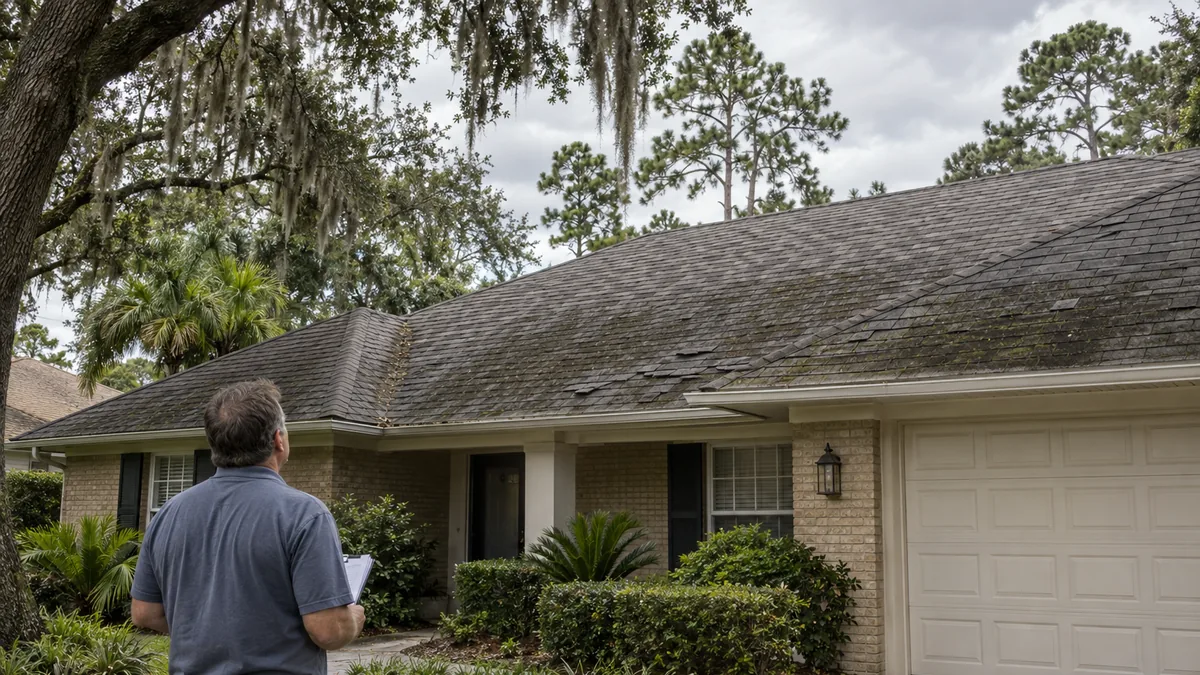
A roof that keeps the rain out is not always a roof your insurer is comfortable with. Across Jacksonville, homeowners with dry ceilings and no leaks are opening renewal letters that ask for a roof inspection, raise questions about roof age, or give notice that the policy will not be renewed. It can feel arbitrary. It is not, although the rules are more technical than most people expect. This post explains why Florida insurers care so much about roof age, what a 2022 law changed, how the different inspections fit in, and what to do, calmly and in order, if a letter about your roof arrives.
Nothing here is legal or insurance advice, and no one can promise what a particular insurer will decide. Confirm every step with your agent or your insurer.
Why Florida insurers care about roof age
Roofs are where hurricane losses start. When wind lifts shingles or tiles, rain follows, and the claim that begins with a roof often ends with drywall, flooring, insulation and contents. Older roofs fail more easily in wind, and in Florida they age faster than in northern states. The sun bakes asphalt shingles, sealant strips lose their grip, granules wash off in afternoon thunderstorms, and the shingles become brittle. In the humid shade under live oaks in neighborhoods like San Marco and Avondale, algae and debris add to the wear.
Roof claims have also been a large part of the cost pressure on the Florida insurance market over the last decade. From an underwriter’s point of view, roof age is one of the easiest ways to predict which houses will produce the next claim, so carriers built rules around it.
Location adds to the picture. Near the ocean in Jacksonville Beach and Atlantic Beach, and along the Intracoastal Waterway and the St. Johns River, salt air corrodes flashing, drip edge and fasteners years before the shingles themselves wear out, and nor’easters push rain sideways under the windward slopes for days at a time. An underwriter looking at a fifteen-year-old roof a few blocks from the water is weighing all of that at once. None of it means a coastal roof is uninsurable. It means the roof’s paperwork, meaning the permit date, the inspection report and the maintenance record, carries more weight than many homeowners expect.
Typical roof age thresholds
Every insurer sets its own underwriting rules, and they change from year to year, so treat these as general patterns rather than fixed numbers.
Many carriers look hard at asphalt shingle roofs around fifteen years old. Some start asking questions earlier, and some will write a policy on an older shingle roof only with an inspection or with limits on how roof damage is paid. Tile and metal roofs are commonly given a longer window, often well into their twenties or beyond, because concrete tile and standing seam metal last longer when properly installed and maintained. On a tile roof, carriers often care as much about the underlayment beneath the tile as the tile itself, since that layer usually wears out first.
The age an insurer uses usually comes from the permit date, the year of construction, a wind mitigation form, or a 4-point inspection. If your roof was replaced and the insurer still shows the original date, that alone can trigger a letter. It is worth checking what date your insurer has on file and correcting it with the permit record. The post on the 25% roof rule explains how to find a roof permit in City of Jacksonville and Beaches city records.
What SB 2-D changed in 2022
In a special session in May 2022, the Florida Legislature passed Senate Bill 2-D, a broad insurance bill. Two of its provisions deal directly with roof age.
First, an insurer cannot refuse to write or renew a homeowner policy solely because the roof is less than fifteen years old. A younger roof can still raise questions about its condition, but its age alone is not a reason to refuse coverage.
Second, for roofs fifteen years old or older, the homeowner can have the roof inspected by an authorized inspector. If the inspection shows the roof has at least five years of remaining useful life, the insurer cannot refuse to write or renew the policy based on roof age alone.
Notice the word “solely.” The law limits using age by itself. An insurer can still act on the roof’s condition, on other features of the house, on claims history, or on its broader underwriting rules. And the law does not set the price of the policy. It is a real protection for homeowners with well-kept roofs, but it is not a guarantee of coverage, and the details of how each insurer applies it should be confirmed with your agent.
4-point inspections and roof inspections
Three different reports come up in these conversations, and they are easy to confuse.
The 4-point inspection covers the roof, the electrical system, the plumbing and the heating and air conditioning. Insurers commonly require it when writing a new policy on an older home, roughly twenty years or more, though the cutoff varies by carrier. The roof portion is brief: covering type, approximate age, estimated remaining life and visible defects such as missing shingles, soft spots or leaks. It is common in Arlington, Lake Shore, Mandarin and other areas where much of the housing dates from the 1950s through the 1990s.
A roof condition inspection is the report that speaks to remaining useful life. It is more detailed than the roof section of a 4-point and is what matters most when your roof is fifteen years old or more. Your insurer may have a specific form it wants, so ask before the inspection.
The wind mitigation inspection, on Form OIR-B1-1802, documents features that resist hurricane wind: roof shape, deck attachment, roof-to-wall connections, secondary water resistance, roof covering and opening protection. It affects the windstorm portion of the premium rather than eligibility. The wind mitigation guide goes through it item by item.
How a roof inspection report helps
A good roof inspection report does three things for you. It gives the insurer evidence instead of assumptions. It tells you honestly how much life your roof has. And it separates small, fixable defects from real end-of-life problems.
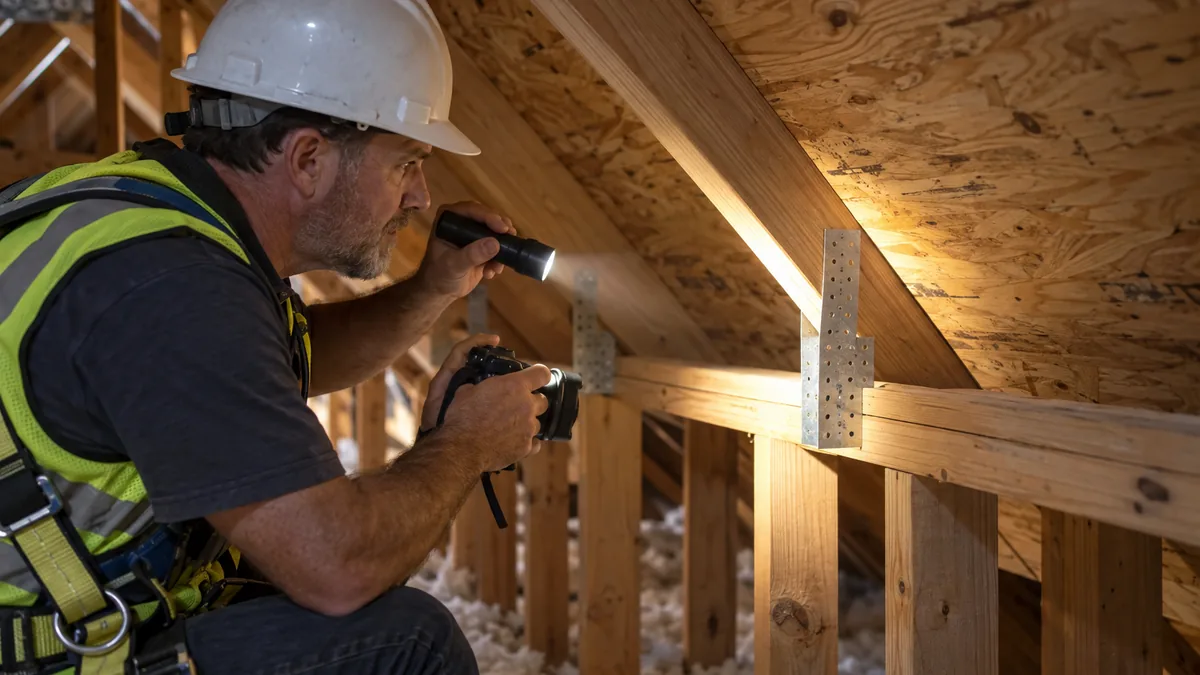
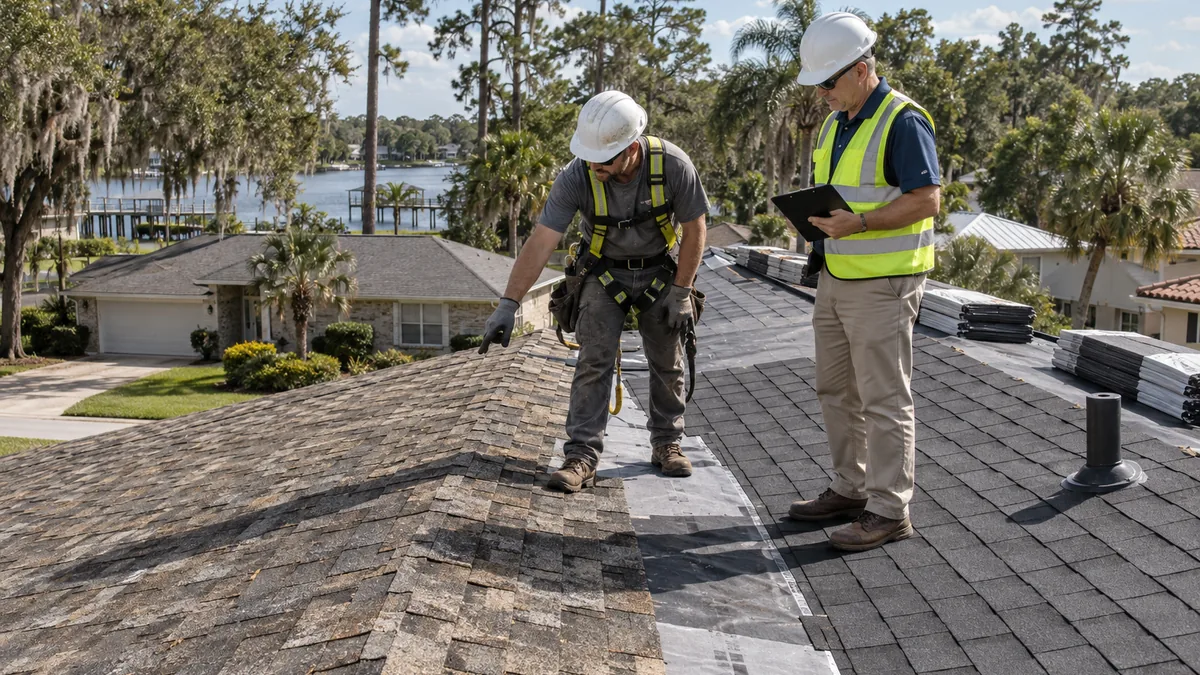
On a roof that is fifteen or more years old, the report should cover every slope with photos, the condition of the shingles or tiles, granule loss, lifted or creased tabs, the ridge and hip caps, flashing at walls, chimneys and skylights, pipe boots, valleys, gutters and fascia, and what can be seen from the attic: daylight, staining, soft decking, ventilation. It should state the roof’s estimated remaining useful life and the basis for that estimate, and it should list any repairs that would extend it.
An honest report cuts both ways. If the roof on a 2008 home in Deerwood is in good shape with a couple of cracked pipe boots, the report should say so. If a 3-tab roof in Southside Estates is brittle and shedding granules, the report should say that too, even though it is not what anyone wants to hear. A report that overstates remaining life may get you through one renewal and cause problems at the next inspection or claim. The roof maintenance and inspection page describes how inspections are done here.
When a non-renewal letter arrives
A letter that says your policy will not renew because of the roof is stressful, but there is usually time to act if you start right away. A sensible order:
- Read the letter closely. Note the exact reason given and the effective date. Florida law requires advance written notice of a non-renewal, and the date on the letter sets your timeline.
- Call your agent. Ask what, specifically, would change the decision: an inspection showing remaining useful life, specific repairs, a replacement, or nothing. Ask for the answer in writing if you can.
- Schedule a roof inspection. Get a written report with photos and a clear statement of remaining life. If the insurer requires its own form, bring it to the inspection.
- Ask your agent to shop other carriers in parallel, including an explanation of what each one requires about the roof.
- Decide on repair or replacement based on the report and what the insurers actually require, not on the pressure of the letter.
Two cautions. Do not let the effective date pass while waiting for one answer, because a gap in coverage is a much bigger problem than a hard conversation. And do not sign a roofing contract on the spot with whoever knocks on the door after hearing about your notice. A few days spent getting an honest inspection and a second estimate is time well spent. The guide to choosing a roofer covers how to verify a license and read an estimate.
Citizens Property Insurance as a last resort
Citizens Property Insurance Corporation is the state-created insurer of last resort in Florida. It exists for homeowners who cannot find reasonable coverage in the private market. Many homeowners in Duval County have moved to Citizens at some point, and many have moved back out as private carriers returned.
Citizens has its own eligibility and underwriting rules, including rules about roof age and condition, and it may require inspections. Whether it is available to you depends on those rules and on the offers you receive from private insurers. A licensed agent who writes Citizens policies can tell you where you stand. It is a safety net, not a way around the roof question, so plan the roof work either way.
Repair or replace
The roof-age question usually ends in one of three places.
A sound roof with minor defects. If the inspection shows at least five years of life with a handful of specific problems, a repair followed by an updated report is often the practical path. Replacing cracked pipe boots, resealing flashing and fixing a few lifted shingles on a well-kept roof in Bartram Park or Julington Creek is straightforward work.
A roof at the edge. A roof with scattered defects and a borderline remaining-life estimate is the hardest case. A repair may satisfy this renewal but not the next. Ask the roofer for both a repair estimate and a replacement estimate, and ask your agent which one the insurer needs.
A roof at the end of its life. Brittle shingles, widespread granule loss and leaks in several places mean a repair is only buying time. A roof replacement resets the age question, gives you a new permit date, and usually improves your wind mitigation form. If the timing is hard, the financing options post outlines the general landscape.
Whichever it is, the steady process in Jacksonville, Florida stays the same: the roof is inspected before anything is priced, the report states the roof’s condition honestly, the estimate is written and itemized, and you confirm with your insurer or agent what they need before any work begins.
Questions on this topic
Can a Florida insurer drop me because my roof is old?
Roof age is a common underwriting factor in Florida, and an insurer can decline to write or renew a policy for reasons that include roof condition. What changed in 2022 is that SB 2-D limits how roof age alone can be used. An insurer cannot refuse to write or renew a policy solely because the roof is less than fifteen years old. For older roofs, you can provide an inspection showing the roof has at least five years of remaining useful life. Read your notice carefully and confirm the details with your insurer or agent.
At what age do insurers start asking about shingle roofs?
Many carriers start looking hard at asphalt shingle roofs somewhere around fifteen years old, and some ask questions earlier. Tile and metal roofs are commonly given a longer window because the materials last longer, though the exact thresholds differ between companies and change over time. Your insurer uses the permit date or the installation date it has on file, so make sure that date is correct. If you replaced the roof and the insurer still shows the old one, send the permit and an updated wind mitigation form.
What is a 4-point inspection and how is it different from a roof inspection?
A 4-point inspection is a short report on four systems: the roof, the electrical system, the plumbing and the heating and air conditioning. Insurers commonly require one on older homes, roughly twenty years or more, when writing a new policy. The roof section notes the covering type, age, remaining life and visible defects. A full roof inspection goes further, with attic observations, flashing, penetrations, decking and photos of every slope. If the roof is the question, the fuller report is the stronger document to have on hand.
What should I do if I get a non-renewal letter because of my roof?
Read the letter for the exact reason and the effective date, then call your agent. Ask whether an inspection showing remaining useful life, a specific repair, or a replacement would change the decision, and get the answer in writing if you can. Schedule a roof inspection promptly so you have a written report and photos. At the same time, ask your agent to shop other carriers. Do not let the deadline pass while you wait, and do not sign a roofing contract in a hurry just because the letter feels urgent.
Is Citizens Property Insurance an option if private insurers will not cover my roof?
Citizens Property Insurance Corporation is Florida's state-created insurer of last resort, meant for homeowners who cannot find coverage in the private market. It has its own eligibility rules, including rules about roof condition and age, and it may require inspections. Whether your home qualifies depends on those rules and on what private offers you receive. Ask a licensed agent who writes Citizens policies to review your situation. It is a safety net, not a guaranteed alternative, so plan the roof work either way.
Is it better to repair or replace an older roof for insurance purposes?
It depends on how much life the roof actually has. If an inspection shows a sound roof with a few specific defects, a repair plus a report documenting remaining life may satisfy your insurer. If the roof is near the end of its life, a repair buys time but will not change its age, and the same question will come back at the next renewal. Ask the roofer for an honest assessment of remaining life, then confirm with your agent what the insurer needs before you choose.
- roof age
- home insurance
- SB 2-D
- 4-point inspection
- non-renewal
- Citizens Property Insurance
- Jacksonville