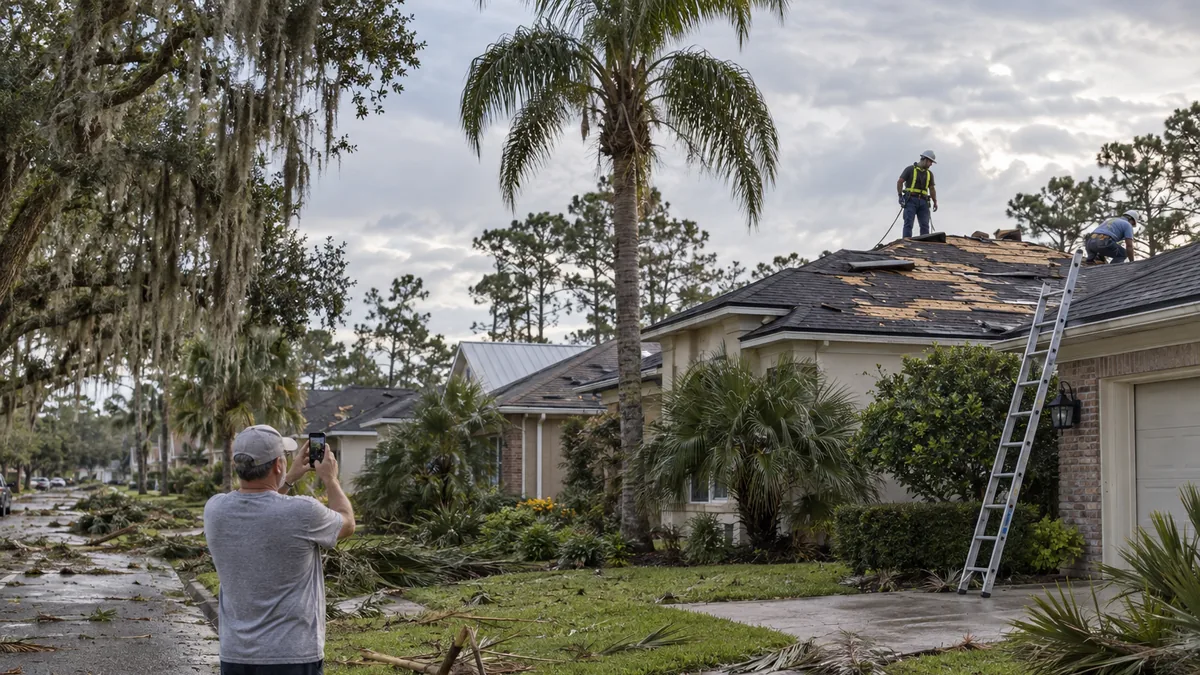
Jacksonville does not get hit by hurricanes the way South Florida does, and that is part of the problem. Matthew in 2016, Irma in 2017 and Dorian in 2019 brushed the coast rather than crossing it, so a lot of homeowners in Duval County have never watched their roof take a direct hit and assume the policy will simply handle it when they do. In practice most of the storm damage here comes from things that never get a name: a nor’easter that parks over the Beaches for three days, a July thunderstorm with a downdraft that peels ridge caps in Baymeadows, a tornado spun off a tropical system that touches down for ninety seconds in Arlington. This guide walks through what to do in the first hour, how tarping and the roofer’s report feed the claim, what Florida law now says about deadlines and deductibles, and how to avoid the people who show up uninvited afterwards.
Jacksonville’s storm patterns
Atlantic hurricane season runs from June 1 to November 30, with the peak from August through October. Even when the eye passes well offshore, Jacksonville gets tropical-storm-force wind, long soaking rain bands that find every weak flashing, and the occasional tornado spun up on the outer bands. Debby in 2024 was mostly a flooding event, but wind-driven rain still found its way under lifted shingles across the Northside and Westside.
Nor’easters are the storm nobody outside the Beaches talks about. In fall and winter, days of onshore wind and rain push water uphill under shingles on the northeast-facing slopes in Jacksonville Beach, Atlantic Beach, Neptune Beach and Ponte Vedra Beach. There is no dramatic moment, just a ceiling stain that appears on the third day.
Summer afternoon thunderstorms carry lightning, strong downdrafts and wind-driven rain, and they hit somewhere in the city almost daily from June through September. Wind uplift on ridge caps, rakes and eaves is the most common storm damage a roofer sees here. Hail is occasional, mostly in spring, and when it comes it bruises shingles, cracks tile, dents metal and fills gutters with stripped granules. Falling limbs from live oaks and pines finish the list, and after every big storm the emergency roof repair page is the busiest one on this site.
The first hour
Safety first. Stay off the roof. Wet shingles are slippery, wet tile and metal more so, and a storm-damaged roof has loose material and soft spots you cannot see. Many storm injuries happen after the weather has passed, to homeowners climbing up for a look. If a power line is down anywhere near the house, keep everyone away from it and call the utility.
Inside, put buckets under drips and move furniture, rugs and electronics out of the wet area. If water is coming through or near a light fixture, ceiling fan, outlet or the electrical panel, turn off the breaker for that circuit, or the main if you are not sure, before touching anything in the room. A sagging ceiling with water behind it can come down; keep people out from under it and, if you are comfortable doing so, poke a small hole at the lowest point with a screwdriver and let it drain into a bucket rather than waiting for it to collapse.
Photograph everything. Ceiling stains, water on the floor, damaged contents, and from the ground only, whatever you can see of the roof: missing shingles, a lifted ridge, a limb, a torn gutter, debris in the yard. If it is safe to enter the attic, photograph wet insulation and daylight through the decking. Note the date and time of the storm. If hail fell, photograph the hailstones beside a coin or a tape measure before they melt. These photos are the beginning of your claim, and no one can take them later.
Then call a roofer for a tarp. Ask for an honest arrival window. After a storm that hit every neighborhood from Oceanway to Julington Creek on the same afternoon, no one can promise a fixed time, and anyone who guarantees sixty minutes is telling you what you want to hear.
Tarping and dry-in
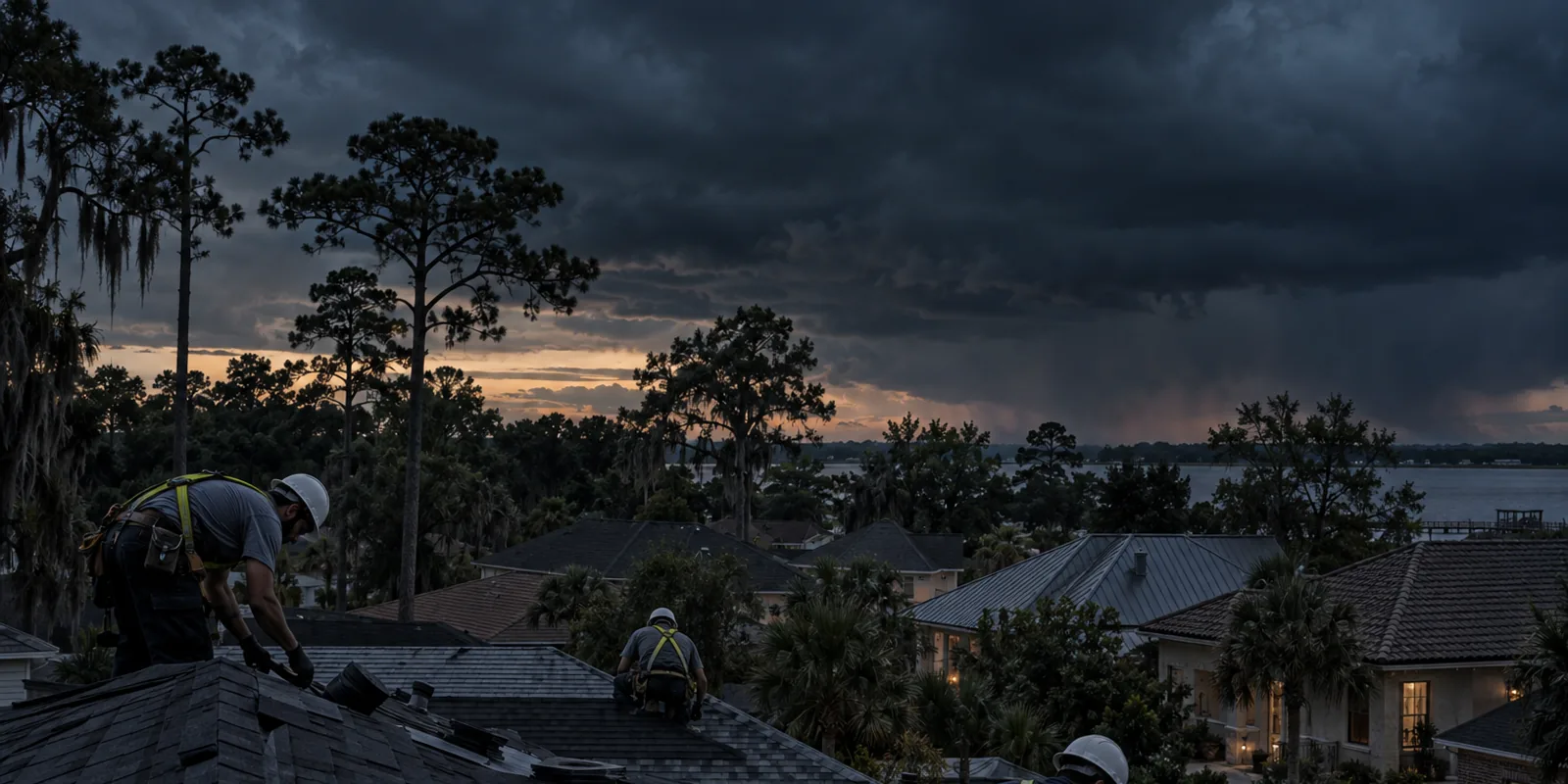
The first visit after a storm is a dry-in, not a repair. The roofer secures the damaged area so no more water gets in and nothing else blows off: a tarp fastened over the opening with battens, a lifted shingle strip sealed down, a displaced ridge cap reset and sealed, a limb removed and the hole covered, or a peel-and-stick patch over a small area. It is done with fall protection and it is priced as its own small job.
Two things matter. Keep the invoice, because insurers generally treat reasonable emergency mitigation as part of the claim, and most policies require you to take reasonable steps to prevent further damage. And understand that the tarp is temporary. A blue tarp left through a season of afternoon thunderstorms will flap, tear and let water in, and it is not a substitute for the permanent repair.
Documenting the claim: the roofer’s report and itemized estimate
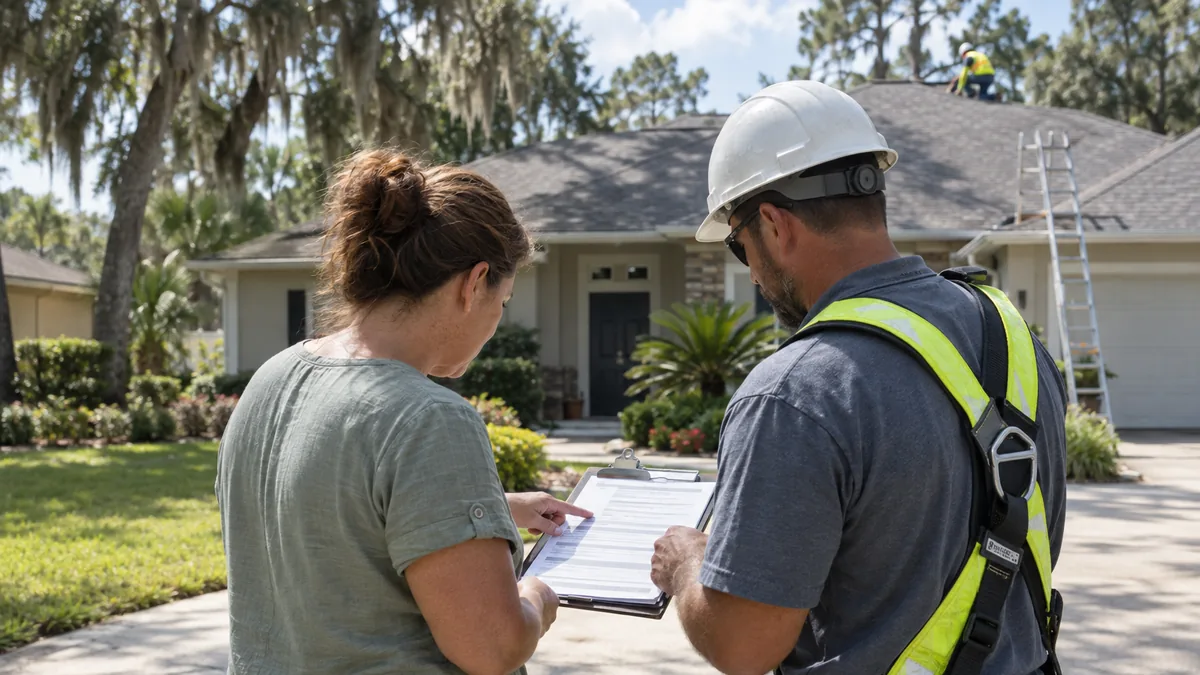
Your insurer wants two documents from a roofer. The first is a written report that describes the damage, states the likely cause and date, distinguishes storm damage from pre-existing wear, and includes photos taken on the roof and in the attic. The second is an itemized estimate for the permanent repair: which slopes, how many shingles or squares, ridge cap, underlayment, flashing, a decking allowance, labor, permit and disposal. An estimate that says storm damage repair and gives one number will be sent back.
The report is where honesty pays. Insurers cover sudden events, so the report should describe the storm and what it did, and it should say plainly if the roofer also found a cracked pipe boot or rusted step flashing that has been leaking since long before the wind. The adjuster will find those anyway, and a report that calls everything storm damage loses credibility for the parts that genuinely are. The process on this site includes photos of the damage and the repair for insurance purposes and an honest report either way.
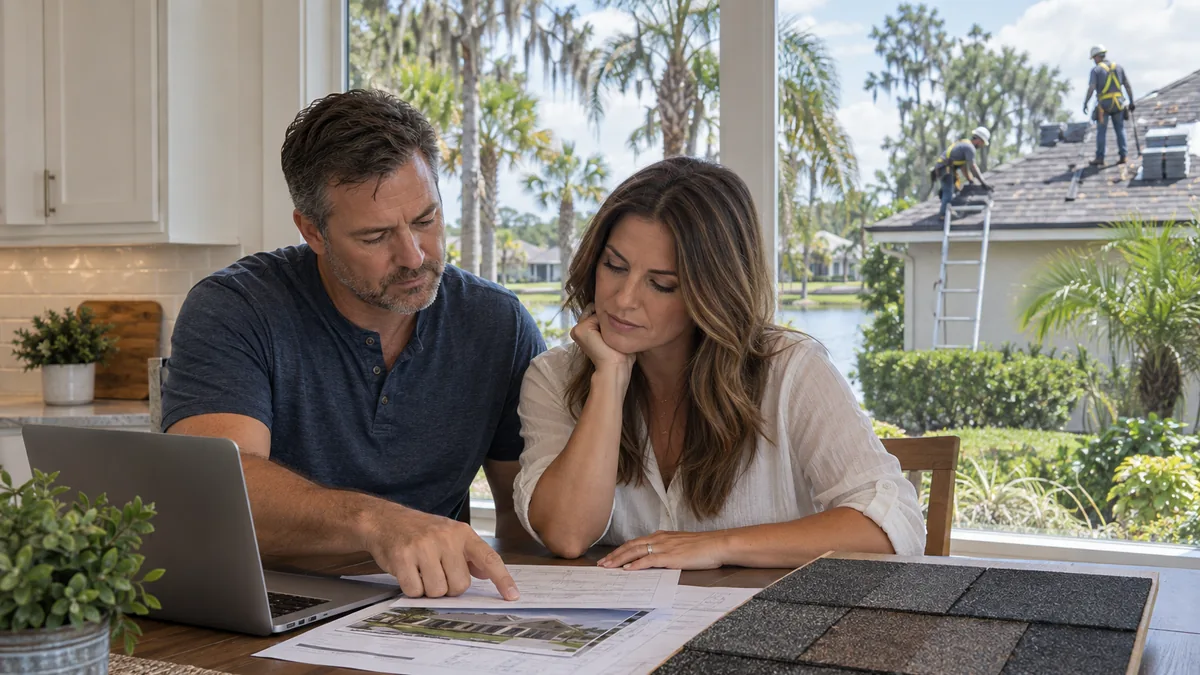
File the claim as soon as you can. Send your photos, the tarping invoice, the report and the estimate together, and keep a copy of everything. Be there when the adjuster comes.
Sudden damage versus wear and tear
This is the line most claims are argued over. Florida homeowner policies generally cover sudden, accidental damage from wind, hail and falling objects, plus the water damage inside that follows. They generally do not cover deterioration: granule loss from years of sun, cracked neoprene pipe boots, rusted flashing near the coast, rotted decking at an eave from a clogged gutter, algae, or shingles that lifted because the sealant strip had already failed with age.
The hard cases are the roofs where both are true. A nor’easter lifts shingles on a fifteen-year-old 3-tab roof in Southside Estates whose seal strips gave out years ago. The wind is the event, the age is the cause, and different adjusters land in different places. A roof in poor condition before the storm is a harder claim, sometimes a denied one, and it is also the roof an insurer may have already flagged at renewal. Florida insurers frequently require inspections on shingle roofs past fifteen years, and a roof that has been maintained and inspected with a record of it is a much easier claim than one with a decade of deferred repairs.
Deadlines and deductibles under Florida law
Two things changed recently and both catch people out.
The filing window. Florida law now gives you one year from the date of loss to file a claim, and eighteen months for a supplemental claim. A supplemental claim is a request for additional payment when the repair uncovers damage the original claim did not include, such as rotted decking under the lifted shingles. Hurricane damage does not always show up on the ceiling right away, so if you suspect it, get the inspection done and the claim filed early, then supplement it if more is found.
Deductibles. Most Florida policies carry two. A standard deductible applies to ordinary wind, hail and thunderstorm damage and is a flat amount. A separate hurricane deductible applies when a named hurricane is declared and is usually set as a percentage of your dwelling coverage rather than a flat figure, which means it can be considerably larger than you expect. Your declarations page shows both. Check them now, before a storm, because the hurricane deductible is often the reason a repair after a named storm ends up paid out of pocket while the same repair after a nor’easter is covered.
Whatever the deductible is, it is yours. Florida statute 489.147 makes it illegal for a contractor to pay, waive or absorb it, and insurers now require a signed statement that it was paid. The cost article explains why an estimate built around hiding the deductible is a bad deal even if it never gets caught.
Adjusters, public adjusters and the end of assignment of benefits
The insurer’s adjuster will inspect the roof, often within a couple of weeks after a widespread event and faster for a single-home claim. Be present. Have your photos, the tarping invoice, the roofer’s report and the estimate in hand. If the adjuster’s scope differs from your roofer’s, ask for the difference in writing and let your roofer respond with photos. Adjusters work from what they can see and what you can document.
A public adjuster is a different person: licensed by the state, hired by you, paid a capped percentage of the settlement, and working on your side. For a straightforward wind repair with a clear report, you probably do not need one. For a large hurricane claim, a disputed cause or a settlement that does not cover the itemized estimate, one can earn the fee. Check the license at myfloridalicense.com and read the contract.
Assignment of benefits is the arrangement you no longer need to consider. Under an AOB, you signed the claim over to the contractor, who then dealt with, and often sued, the insurer in your name. Florida largely eliminated AOB for roofing in 2022 and 2023. Any document that transfers your claim, your benefits or your right to sue to a roofer is one you should not sign, and a roofer who leads with it is not one you should hire.
Storm chasers
After every named storm, and after every serious nor’easter at the Beaches, crews from out of town arrive in the hardest-hit streets. They knock on doors, offer a free inspection, find damage on every roof, and want a signature today. Some are legitimate roofers who follow storms for a living. Many are not, and the ones who are not tend to be gone by the time the roof leaks again.
The warning signs are consistent: no local address, a phone number set up last month, no permit history with the City of Jacksonville, magnetic signs on the truck, an offer to handle the insurance for you, an offer to cover the deductible, pressure to sign before the adjuster arrives, and a deposit request before any material shows up. The guide to choosing a roofer walks through verifying a DBPR license, insurance and permit history, and every step of it applies double after a storm. A licensed local roofer will give you the CCC number without being asked twice.
After the repair: wind mitigation and the next storm
Once the claim is settled and the permanent repair is done, two things are worth doing. First, get a wind mitigation inspection on Florida form OIR-B1-1802 if you do not have a current one. It documents the roof shape, deck attachment, roof-to-wall connections, secondary water resistance, roof covering age and opening protection, and insurers are required to offer discounts for the features it verifies. A repair that added a sealed deck or peel-and-stick underlayment, or a replacement done under a permit to the current Florida Building Code, can change the form and therefore the premium. No number is promised here, because it depends on your insurer and your house.
Second, fix the things the storm exposed but the claim did not cover: the pipe boots, the valley full of pine needles, the flashing that was rusting anyway. Those are the leaks the next thunderstorm will find. The roof leak repair page describes how they are found and priced, and the process is the same whether or not an insurer is involved: the roof is inspected, the estimate is written and itemized, and nothing starts in Jacksonville, Florida until you approve it.
Questions on this topic
Should I go up on the roof to check for damage after a storm?
No. Wet shingles are slippery, wet metal and tile more so, and a storm-damaged roof has loose material, hidden soft spots over rotted decking, and possibly a downed line nearby. A large share of storm injuries happen after the weather has passed, to homeowners climbing up for a look. Photograph what you can see from the ground and from inside the attic if it is safe to enter, put buckets under active drips, and call a roofer for a tarp. Crews work with harnesses and fall protection for a reason.
Does homeowner insurance in Florida cover storm damage to a roof?
Most Florida homeowner policies cover sudden damage from wind, hail, falling trees and the resulting water damage inside. They generally do not cover wear and tear, rot, rusted flashing, cracked pipe boots that have been failing for years, or damage that resulted from lack of maintenance such as a valley clogged with pine needles. Hurricane damage is usually subject to a separate deductible set as a percentage of your dwelling coverage rather than a flat amount. Read your own policy's wind and hurricane sections, and do not let anyone promise you what your insurer will pay.
How long do I have to file a roof damage claim in Florida?
Florida law currently gives you one year from the date of loss to file a new claim, and eighteen months for a supplemental claim, which is a request for additional payment when the repair uncovers damage the original claim did not include. That is much shorter than it used to be, and it is easy to miss when a leak from a hurricane does not show up on the ceiling until months later. If you suspect storm damage, get the roof inspected and the claim filed early, then supplement it if the repair finds more.
What does the insurer need from the roofer?
A written report describing the damage, stating the likely cause and date, distinguishing storm damage from pre-existing wear, with photos taken on the roof and in the attic. And an itemized estimate for the permanent repair listing slopes, shingle counts or squares, ridge cap, underlayment, flashing, decking allowance, labor, permit and disposal. Send both with your own photos and the tarping invoice when you file. A single figure labeled storm repair will be sent back, and a report that overstates the damage loses credibility for the whole claim.
Should I hire a public adjuster for a roof claim?
It depends on the size and complexity of the claim. A public adjuster is licensed by the state, works for you rather than the insurer, and is paid a percentage of the settlement that Florida caps. For a straightforward wind repair with a clear report and estimate, you may not need one. For a large hurricane claim, a disputed cause, or a lowball settlement, one can be worth the fee. Check the license at myfloridalicense.com, read the contract, and never confuse a public adjuster with a roofer who offers to handle the claim.
What is a wind mitigation inspection and why do it after a roof repair?
It is a standardized inspection on Florida form OIR-B1-1802 that documents the features of your roof that reduce hurricane damage: roof shape, deck attachment, roof-to-wall connections, secondary water resistance, roof covering age and permit, and opening protection. Insurers are required to offer premium discounts for the features it verifies. After a repair or replacement that added a sealed deck or peel-and-stick underlayment, or after an older roof is replaced under a permit, a new inspection can change what you pay. It is done by licensed inspectors and contractors.
- hurricane damage
- storm damage
- wind damage
- hail damage
- insurance claim
- tarping
- wind mitigation