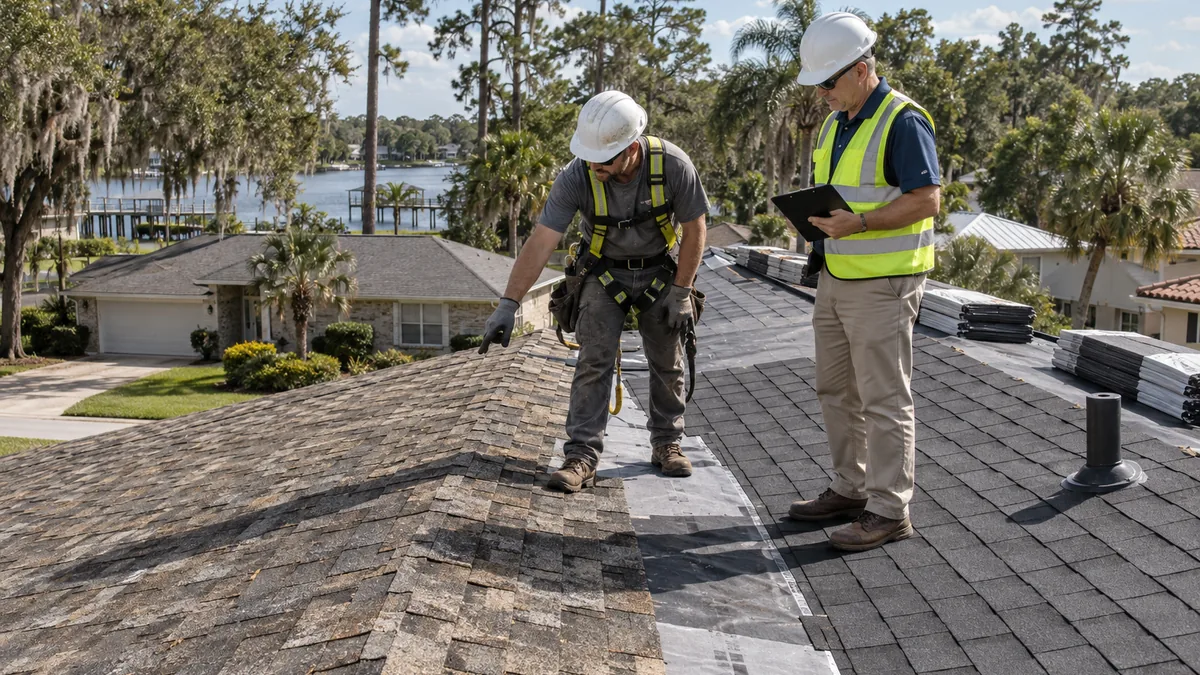
Ask a few Jacksonville homeowners about the 25% rule and you will hear a range of stories. One neighbor in Arlington had a limb take out part of a slope and ended up with a new roof. Another in Mandarin was told the same kind of damage could be patched. A third heard from a door-knocker that the rule meant the insurer had to pay for everything. All three may have been told something that was true for their roof at the time, because the rule was real, it was changed in 2022, and which version applies still depends on when the roof went on. This post explains how the rule worked, what Senate Bill 4-D changed, how to find your roof’s permit year in Duval County, and what a roofer should write down before any work starts.
Nothing here is legal advice. Code details vary by roof and by the building official reviewing the permit, so the steady answer throughout is the same: ask the roofer and the building department which rule applies to your roof.
What the 25% rule actually said
The rule lived in the part of the Florida Building Code that governs existing buildings. In plain terms, if more than 25% of a roof section was repaired, replaced or recovered within any twelve-month period, that entire roof section had to be brought up to the code in force at the time of the work. It could not simply be patched to match what was already there.
Two details matter. First, the rule applied to a roof section, not the whole house. A roof section is generally an area bounded by ridges, hips, valleys, eaves and rakes, so a simple gable roof on a 1960s ranch in Southside Estates might have two sections while a cut-up roof on a newer home in Bartram Park could have a dozen. The same square footage of damage could cross the threshold on one house and fall well short on another.
Second, the twelve-month window counted all the work done in that period. A small repair in the spring and another after an August thunderstorm could add up. That is one reason a roofer would ask what else had been done to the roof recently.
Why it pushed homeowners into full replacements
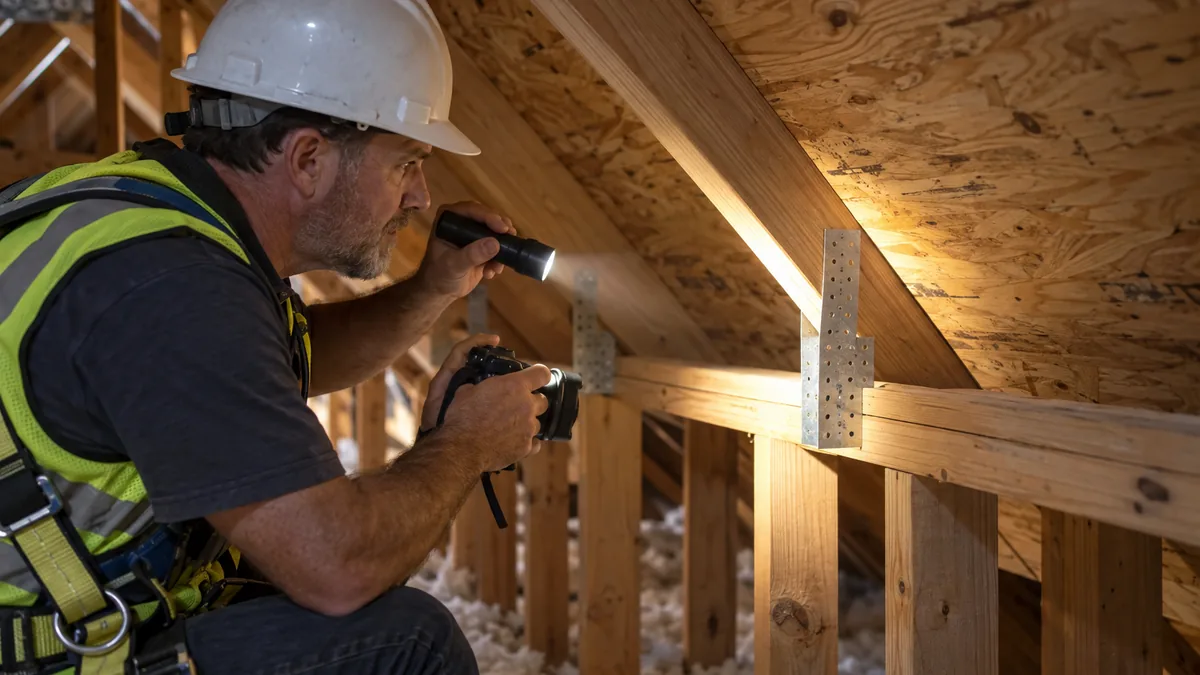
On paper, bringing one section up to code sounds modest. In practice, older roofs in Jacksonville rarely met the current code. Requirements for underlayment and secondary water barriers, deck fastening with ring-shank nails, shingle nailing patterns for high-wind areas, and drip edge had all tightened over the years. You cannot install modern underlayment under half a slope, and you cannot re-nail the decking under shingles that stay in place. So once a repair crossed the threshold, the practical answer was usually to tear off the whole section and rebuild it.
On a simple roof, one section can be most of the roof. That is how a storm that damaged one slope in Cedar Hills or Fort Caroline could turn into a full roof replacement. The rule also found its way into insurance claims. If a storm damaged more than a quarter of a section, the argument went, the code required a full section and therefore the policy should pay for it. That logic drove a large number of full-roof claims in Florida and became part of the wider conversation about insurance costs that led to changes in the law.
What Senate Bill 4-D changed in 2022
In a special session in 2022, the Florida Legislature passed Senate Bill 4-D, and one of its provisions dealt directly with the 25% rule. The change works like this: if the existing roof was built or replaced in compliance with the 2007 Florida Building Code or a later edition, a repair, replacement or recovering of part of that roof only has to meet the code the roof was built to, even when the work covers more than 25% of a roof section. The rest of the section does not have to be torn off and rebuilt to current code just because the damaged area crossed the line.
The reasoning is that roofs built under the 2007 code and later already include much of the wind resistance the older rule was trying to force into old roofs.
What SB 4-D did not do is erase the rule for every roof. Roofs installed under codes older than the 2007 edition may still fall under the original threshold. It also did not change the requirement to pull a permit when the work calls for one, and it did not decide anything about what an insurer pays. It changed a code requirement, and the building official still applies it.
A practical wrinkle: the 2007 edition of the Florida Building Code did not take effect on January 1, 2007. Code editions take effect after they are adopted, so a roof permitted in 2007 or 2008 may have been built under an earlier edition. If your permit falls in that period, it is exactly the kind of detail to ask the roofer and the building department about rather than assume.
How to find your roof’s permit year in Jacksonville
Since everything turns on when the roof was built or last replaced, the permit record is the document that matters most. Here is where to look.
City of Jacksonville permit records. Duval County and the City of Jacksonville are consolidated, so for most addresses from Oceanway to Julington Creek, the City of Jacksonville Building Inspection Division holds the permit history. You can search its online records by address and look for a roofing or re-roof permit. Note the application date, the issue date and whether the permit shows a final inspection.
The Beaches cities. Jacksonville Beach, Atlantic Beach and Neptune Beach each run their own building departments, and their records are separate from the city’s. If you live east of the Intracoastal Waterway in one of those cities, check with that department. Homes in Atlantic Beach and Neptune Beach are sometimes searched in the wrong system and come back with no roof permit at all. Ponte Vedra Beach falls under St. Johns County, which keeps its own records.
The seller’s disclosure and closing file. If you bought the house in the last several years, the seller’s disclosure may state when the roof was replaced, and the closing file may include a wind mitigation form or 4-point inspection report that lists a roof permit date. These are useful leads, but confirm them against the actual permit record.
Your own paperwork. If you replaced the roof yourself, the contract, the final invoice and the permit card the roofer left should all show the date.
If no permit turns up, the roof may predate online records or the search may need a different address format. A roofer can estimate a roof’s age from the shingle type and condition, but that estimate is not a substitute for a permit when the code question is on the table.
How the rule interacts with insurance and roof age
The 25% rule and roof age are separate issues that tend to show up in the same conversation.
Florida insurers pay close attention to how old a roof is, and many carriers look hard at shingle roofs around fifteen years old. The permit date you find for the 25% question is often the same date your insurer uses for roof age. A roof permitted under the 2007 code or later benefits twice: it can usually be repaired rather than replaced after partial damage, and it is younger in the eyes of underwriting. The post on roof age and home insurance in Florida goes into the underwriting side in detail.
On a claim, the insurer decides what the policy covers based on the damage, the policy language and its adjuster’s findings. SB 4-D means a newer roof that can legally be repaired will generally be scoped as a repair. On an older roof that still falls under the original rule, the code requirement may be part of the discussion, and some policies include ordinance or law coverage that deals with the cost of meeting current code. Whether yours does, and how much it covers, is a question for your agent or insurer. Nobody on this site can tell you what an insurer or building official will decide, and you should be wary of anyone who says they can.
The permit record also feeds your wind mitigation form, which lists the roof covering and its permit date. After a re-roof, an updated wind mitigation inspection is how that new date reaches your insurer.
What your roofer should put in writing
When the 25% rule could come into play, the estimate should do more than list shingles and labor. Ask for these items in writing.
- The roof permit year the roofer relied on, and where it came from: the City of Jacksonville record, a Beaches city record, or the roofer’s own estimate if no permit was found.
- Which rule the roofer is applying. A plain statement such as “roof permitted under the 2007 code or later, repair to match existing” or “roof predates the 2007 code, section replacement required above the threshold.”
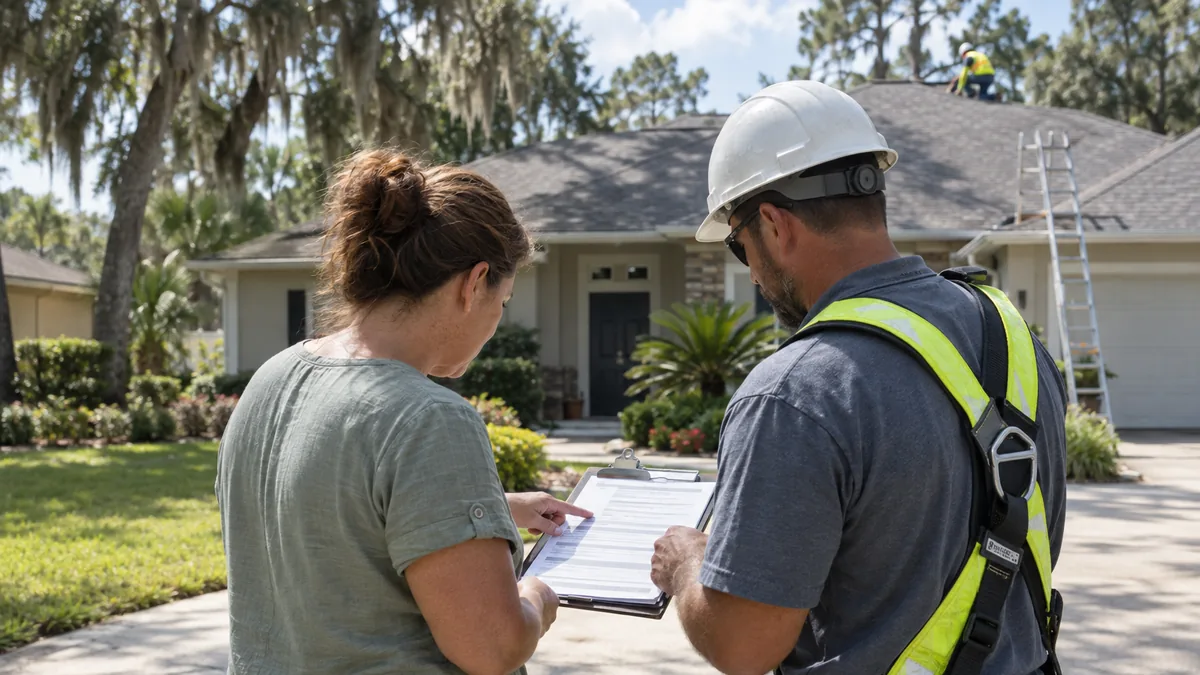
- A description of the roof sections involved and the approximate share of each section being repaired, with photos or a simple sketch.
- Whether a permit will be pulled, with which department, and the permit as a line item.
- The scope for any decking, including how rotted sheathing will be priced if it is found once the roof is open.
- Materials and how they match, since a repair on a newer roof still has to be done with compatible, approved products.
If the roofer’s answer changes the job from a repair into a replacement, it is reasonable to call the building department yourself and ask. A good roofer will welcome the confirmation. The shingle roof repair page describes how partial repairs are scoped on the asphalt roofs that cover most Jacksonville homes.
Common scenarios around Jacksonville
A few patterns come up again and again.
A 2010s roof in Bartram Park with storm damage on one slope. Permitted well after the 2007 code took effect, this roof is generally a candidate for repair even if the damage covers much of that slope. The main questions are shingle matching and whether the underlayment was damaged.
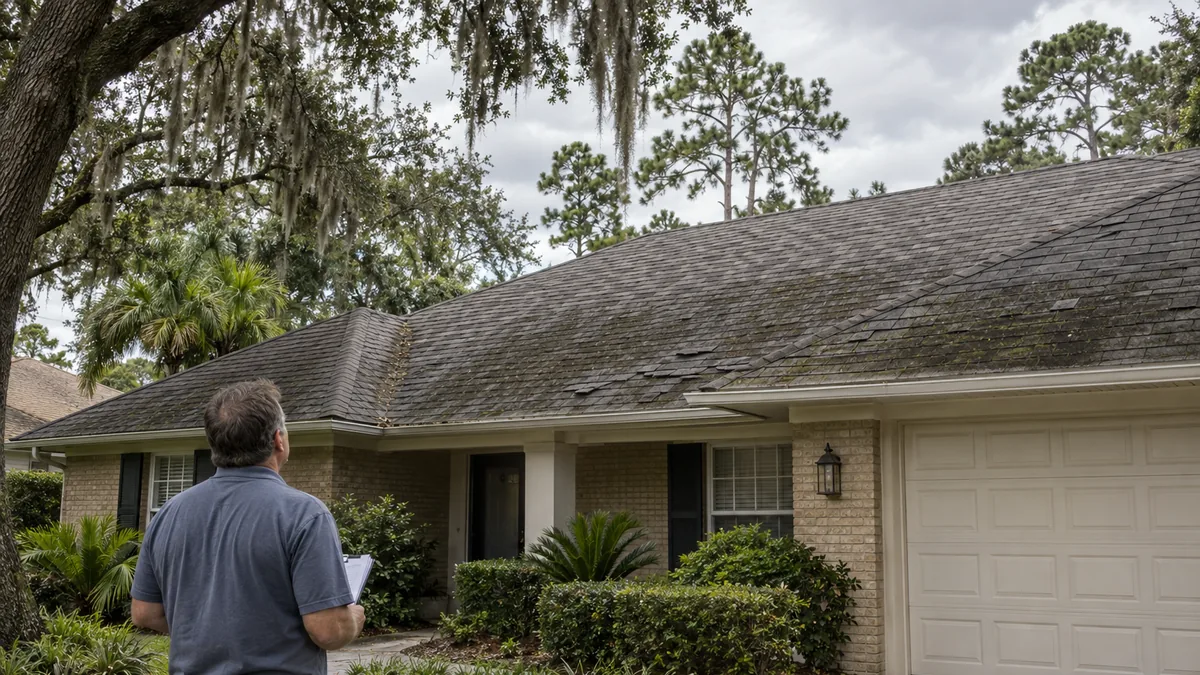
A 1990s roof in Baymeadows or Mandarin with a fallen limb. If there is no newer re-roof permit, this roof may still fall under the original rule. If the damage crosses the threshold for that section, the section may need to be rebuilt to current code, and with 3-tab shingles near the end of their life, a full replacement often makes more sense anyway.
A historic home in Riverside with a steep, cut-up roof. Many small sections mean a modest amount of damage can cross the threshold on one small section without touching the others. The permit year and the section layout both matter, and the roofer should sketch them out.
A Beach Blvd area home with a permit from 2007 or 2008. This is the gray zone described above. Ask which code edition the permit was reviewed under before assuming either answer.
Repair or replace is still your decision
SB 4-D gives many Jacksonville homeowners a choice they did not have before, but it does not make the choice for them. A newer roof with a few storm-damaged sections and plenty of life left is a clear repair. A roof that can legally be repaired but is showing granule loss, brittle shingles and leaks in several places may be the wrong place to spend repair money, particularly if the insurer is already asking about roof age.
The honest way to decide is to ask for both numbers: a repair estimate and a replacement estimate, each itemized. The roof repair cost guide explains what moves those figures and how to compare them. And whichever way you go in Jacksonville, Florida, the process should be the same: the roof is inspected, the rule the roofer is applying is written down with the permit year behind it, the permit is pulled when the work requires one, and nothing starts until you have read it and agreed.
Questions on this topic
What was the 25% roof rule in Florida?
It was a provision in the Florida Building Code for existing buildings. If more than a quarter of a roof section was repaired, replaced or recovered within a twelve-month period, that entire section had to be brought up to the current code rather than patched to match the old work. Because older roofs rarely met the current code, the practical result was often a full section replacement, and on a simple roof that could mean most of the roof. It applied by roof section, not by the whole house.
What did Senate Bill 4-D change about the 25% rule?
SB 4-D, passed in a 2022 special session, changed how the rule applies to newer roofs. If your existing roof was built or replaced in compliance with the 2007 Florida Building Code or a later edition, a repair can be done to match that roof without triggering replacement of the whole section, even when the damaged area is larger than a quarter of it. Roofs installed under earlier codes may still fall under the original rule. The details vary by roof, so ask the roofer and the building department which rule applies to yours.
How do I find out what year my roof was permitted?
Start with the City of Jacksonville permit records, which cover most of Duval County, and search by your address for a roofing or re-roof permit. If you live in Jacksonville Beach, Atlantic Beach or Neptune Beach, those cities keep their own building department records. Your closing papers, the seller's disclosure, an older wind mitigation form or a 4-point inspection report may also list a permit date. If no permit turns up, a roofer can estimate the roof's age from its materials, but that is not the same as a permit record.
Does the 25% rule decide whether insurance pays for a full roof?
Not by itself. The rule is a building code matter that decides what a repair must meet, while your insurer decides what the policy pays for based on the damage, the policy language and its own adjuster. The two used to be linked in many claims, which is part of why the legislature changed the rule. Today a newer roof that can legally be repaired will usually be treated as a repair. Confirm how your own policy handles it with your insurer or agent, and do not rely on any roofer's promise about a payout.
Can a roofer tell me for sure which rule applies to my roof?
A good roofer can tell you what the permit history shows, what the roof is made of and how large the damaged area is compared with the roof section. The final word on code compliance belongs to the building official who reviews the permit and inspects the work. That is why the estimate should state which rule the roofer is applying and why, based on the permit year. If the answer changes the job from a repair to a replacement, it is reasonable to ask the building department directly before you sign.
Is it ever smarter to replace a roof even if the 25% rule does not require it?
Yes. SB 4-D allows a repair on a newer roof, it does not make the repair the right choice. If the shingles are near the end of their life in the Florida sun, if leaks are showing up in several places, or if your insurer is asking questions about roof age, a replacement may cost less over the next few years than a series of repairs. The code question and the value question are separate. Ask for both a repair estimate and a replacement estimate so you can compare them honestly.
- 25% rule
- Florida Building Code
- SB 4-D
- roof permits
- roof replacement
- Jacksonville