Type “best roofing companies in Jacksonville FL” into a search box and you get lists. Some are paid placements, some are aggregated from review sites, and some are written by roofing companies about themselves. None of them can tell you whether the crew that shows up at your house in Arlington next Tuesday will be licensed, insured, and honest about what your roof needs. This article does not name or rank anyone, including the roofer behind this site. It gives you a checklist you can apply to any company in Duval County, so that “best” becomes a set of things you verified rather than a word you read.
Start with the license, not the reviews
Florida requires roofing contractors to be licensed by the Department of Business and Professional Regulation through the Construction Industry Licensing Board. There are two kinds. A Certified Roofing Contractor holds a license beginning with CCC and can work anywhere in the state. A Registered Roofing Contractor holds a license beginning with RC and is limited to the counties where they are registered. Either is legal in Jacksonville, but you should know which one you are dealing with and confirm it covers Duval County, or St. Johns County if you are in Ponte Vedra Beach.
Verify the number at myfloridalicense.com, the DBPR’s public lookup. Check three things: the status is current and active, the name on the license matches the name on the estimate and the truck, and there are no unresolved complaints or disciplinary actions. A general contractor license is not a roofing license. A handyman license does not exist in Florida for roofing. A number that “belongs to a partner” is a rented license, and rented licenses are how unlicensed crews end up on roofs.
Unlicensed roofing work is a crime in Florida. It also voids many insurance claims and creates problems when you sell the house and the buyer’s inspector asks for the permit. This is the first filter, and it removes more companies than you would expect.
Ask for the certificate of insurance and call the insurer
A roofing company should carry general liability insurance, which covers damage to your property, and workers’ compensation, which covers a worker hurt on the job. If a roofer falls off your roof and the company has no workers’ compensation coverage, the injury claim can come to you as the property owner. This is not a hypothetical. Roofing is one of the most dangerous trades in the country.
Ask for a certificate of insurance. It should come from the insurance agent, be dated, name the company, and list both policies with limits and expiration dates. Then call the agent listed on the certificate and confirm the policy is in force. Certificates are easy to fake and easy to let lapse. Florida law requires roofing companies to carry workers’ compensation, and an owner’s personal exemption does not extend to the crew.
A company that hesitates at this request, or offers a photocopy from three years ago, has told you what you need to know.
Local address and permit history
Storm chasers operate out of hotel rooms and rented trucks. Established Jacksonville roofers have a physical address you can find, a history of pulling permits with the City of Jacksonville Building Inspection Division, and jobs you can drive past in Mandarin, Riverside or Jacksonville Beach. Look up the address. A registered agent’s office or a mailbox store is not a roofing company.
Permit history is public. The City of Jacksonville and the Beaches cities keep searchable records of building permits, and a company that has been doing re-roofs here for years will have a long trail of them. A company with no permits in Duval County either does not do work that requires them, does the work without pulling them, or has not been here long. All three are worth knowing before you sign.
How to read reviews
Reviews are useful once you know what to ignore. Volume by itself means little; a company can buy reviews, and a company doing careful work on a small scale may have few. Read for three things.
Recency. A company can change ownership, lose its best foreman, or shift from repairs to insurance replacements. Reviews from the last twelve months describe the company you are hiring. Reviews from six years ago describe a different one.
Specifics. A useful review names the neighborhood, the kind of work, whether the estimate matched the final invoice, whether the crew showed up when they said they would, and how the yard looked afterwards. “Great job, highly recommend” tells you nothing. Twenty of those posted within the same week tell you something else.
Responses. Read the negative reviews and the company’s replies. Every roofer who has been in business long enough has a few. A calm, factual reply that explains what happened and what was done about it is the best evidence you will find of how the company handles problems. Defensive replies, or silence, are also evidence.
Check more than one platform, and if you can, ask the company for two or three recent customers in your part of Jacksonville who you can call. Local references from Baymeadows or Ortega beat anonymous stars.
The estimate: written, itemized, after an inspection
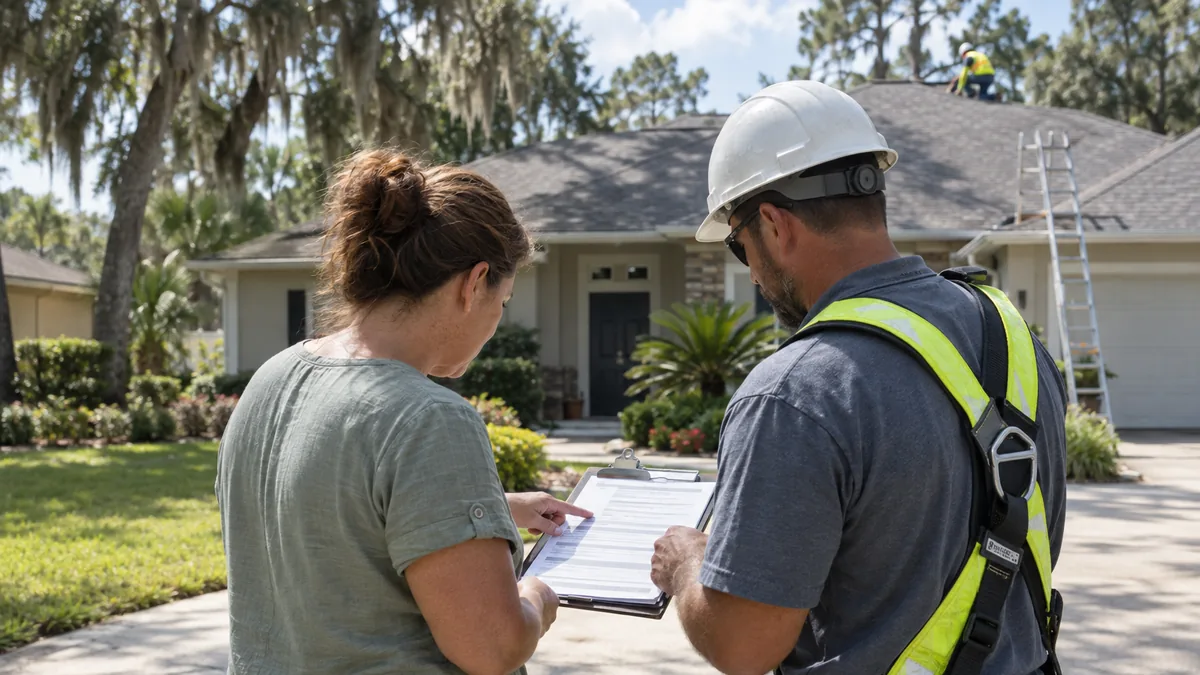
The single most reliable tell is how the company arrives at its price. A roofer who quotes over the phone without seeing the roof is guessing. A roofer who walks the roof, checks the attic when there is a leak, photographs what they find, and then writes an itemized estimate is doing the job properly, and the estimate will show it.
A proper estimate lists:
- Scope of work by slope or area, with what is excluded stated plainly.
- Materials by brand and product line: shingles, underlayment, drip edge, flashing metal, fasteners, ridge vent, sealant.
- Labor for the specific task.
- A per-sheet rate for any rotted decking found once the roof is open, and a promise that extra work is priced before it is done.
- Permit and inspection fees if the job requires them.
- Disposal, cleanup, and a magnetic sweep for nails.
- Payment terms, with a deposit that is reasonable relative to the material cost.
- A start window and an expected duration.
The cost article explains what moves each of those lines. The pricing page describes how estimates are built on this site.
Warranty in writing
Two warranties matter. The workmanship warranty is the roofer’s promise that the installation will not leak, and it should state a term in years and what it covers. The manufacturer warranty covers the product, and its length depends on the shingle line and on whether the installer is certified. Both should be written into the estimate or attached to it, and you should receive the manufacturer registration after the job. A verbal “we stand behind our work” is not a warranty.
Manufacturer certifications and what they mean
GAF, Owens Corning and CertainTeed, the three largest shingle manufacturers, run installer programs with tiers. To qualify, a company typically has to show a state license, adequate insurance, a track record, and training. Higher tiers involve installation audits. A certified installer can offer an enhanced manufacturer warranty, sometimes covering workmanship as well as materials for a longer period, that a non-certified installer cannot.
This matters in two ways. The certification is a reasonable signal that the company is stable enough to have gone through the process. And if you want the longer warranty on a roof replacement, you need a certified installer for that brand. It does not replace checking the license and insurance yourself, and it says nothing about whether the company will pick up the phone when a pipe boot leaks in year three.
Deductibles, assignments of benefits and storm chasers
Florida has specific rules here and they are worth knowing before anyone knocks on your door after a hurricane.
Deductibles. Florida statute 489.147 prohibits a contractor from paying, waiving, rebating or absorbing your insurance deductible, and it requires contractors to give you a written notice about your deductible obligations. A roofer who offers a “free roof” through your insurance, or suggests inflating the estimate to hide the deductible, is proposing fraud. End the conversation.
Assignment of benefits. Under an AOB, you signed your insurance claim over to the contractor, who then dealt with the insurer, and sometimes sued them, in your name. Florida largely eliminated AOB for roofing in 2022 and 2023. Anyone asking you to sign a document that transfers your claim, your benefits, or your right to sue is asking you to sign something that is either unenforceable or against your interest.
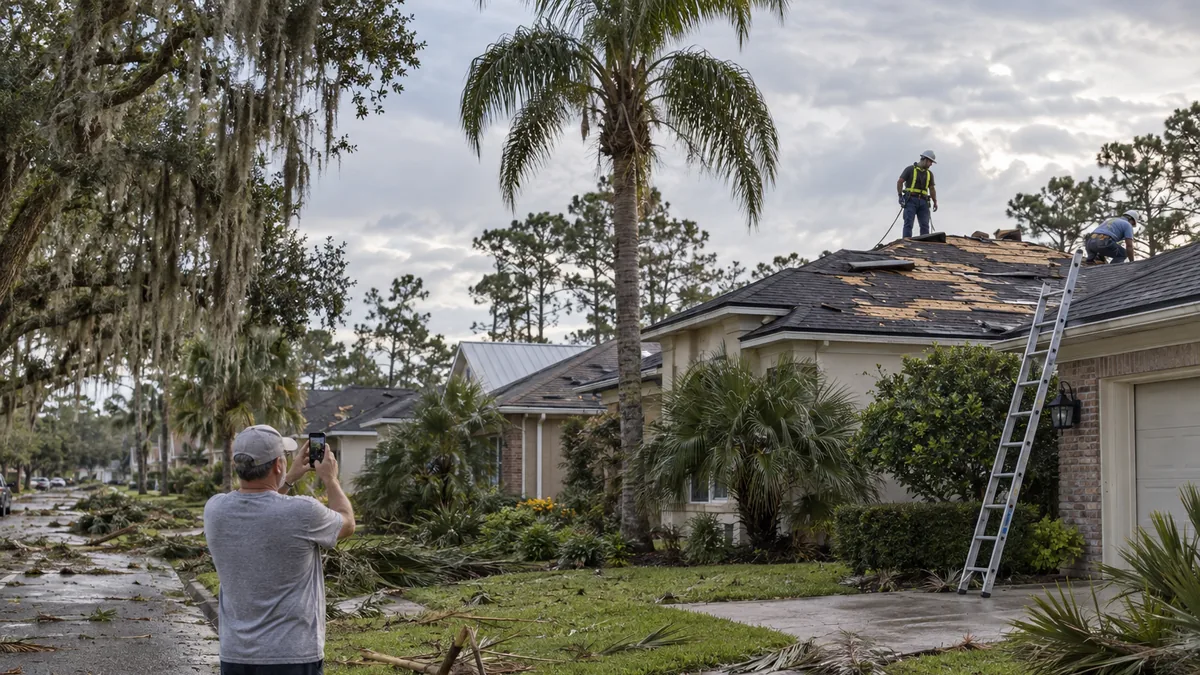
Storm chasers. After every named storm and every serious nor’easter at the Beaches, out-of-town crews arrive in the hardest-hit neighborhoods. Some are legitimate. Many are not. The warning signs repeat: door-knocking, a local phone number set up last month, no permit history, a truck with magnetic signs, pressure to sign today because “the adjuster is coming”, and a request for a deposit before any material arrives. The storm damage guide covers this in detail. A company that has been in Jacksonville for years does not need to knock on doors.
Questions to ask before you sign
Ask these on the phone or during the inspection. The answers, and the willingness to answer, tell you a lot.
- What is your DBPR license number, and is it a CCC or RC license?
- Can you send a certificate of insurance from your agent, and may I call them?
- Who is the crew: your employees, or a subcontractor? If a sub, are they licensed and insured too?
- Will you inspect the attic as well as the roof?
- Does this job require a permit, and will you pull it?
- Which rule applies to my roof, the old 25% rule or the Senate Bill 4-D exception, and why?
- What shingle line and underlayment are you specifying, and why that one for a Florida roof?
- What is the workmanship warranty, in years, and what does it exclude?
- How is extra work handled if you find rotted decking?
- What is the deposit, when is the balance due, and what happens if the weather delays the job?
- Who do I call if the roof leaks a year from now?
A good roofer has heard every one of these before and has short, direct answers. A roofer who bristles at them is telling you how the job will go.
Comparing three estimates line by line
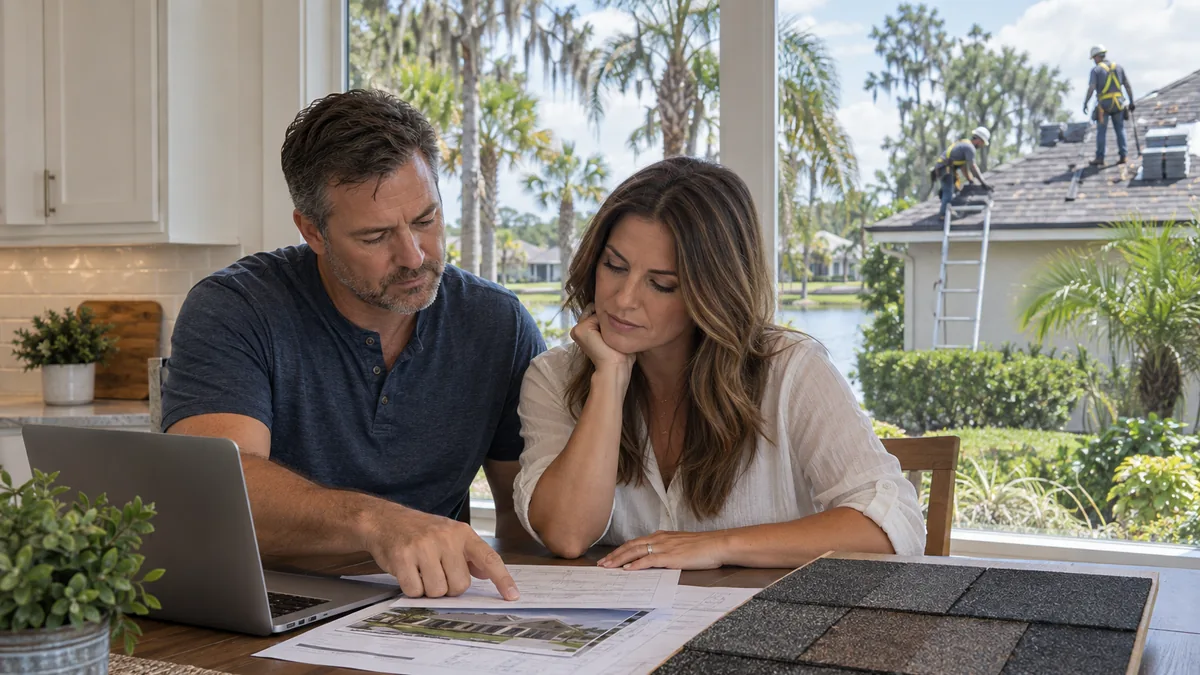
Get three estimates for anything larger than a pipe boot. Then compare them properly, which means not by the number at the bottom.
Put them side by side and check that they describe the same job. If one says repair and another says replacement, ask why. The answer may be the 25% rule, or it may be one roofer looking harder than the other. If one specifies a synthetic underlayment and another says “felt”, you are not comparing the same roof. If one includes a permit and another does not, the one without is either skipping it or will bill it later.
Look at decking. An estimate that includes a per-sheet rate for rot is being honest about an unknown. An estimate that ignores decking is either assuming the best or planning a change order.
Look at the warranty. A longer workmanship warranty from a company with a ten-year permit history in Duval County is worth something. The same warranty from a company that arrived after the last hurricane is worth exactly as long as they stay.
Then look at the number. The lowest bid is sometimes the best one, when it comes from a licensed, insured, local company with a complete scope. It is rarely the best one when it is low because something has been left out.
None of this is complicated, and none of it requires trusting anyone’s word, including the word of the company behind this site. The residential roofing page describes the process this site promises: inspection first, written itemized estimate, licensed contractor, permits pulled, and extra work priced before it is done. Hold every roofer in Jacksonville, Florida to the same standard, and the best one will identify itself.
Questions on this topic
How do I check whether a roofer is licensed in Florida?
Go to myfloridalicense.com, the public lookup run by the Florida Department of Business and Professional Regulation, and search by the license number or the business name. A Certified Roofing Contractor license begins with CCC and is valid statewide. A Registered Roofing Contractor license begins with RC and is limited to specific counties. Check that the status is current and active, that the name on the license matches the name on the estimate, and that there are no unresolved disciplinary actions. A general contractor license is not a roofing license.
What insurance should a roofing company in Jacksonville carry?
Two policies at minimum: general liability, which covers damage to your property, and workers' compensation, which covers a worker hurt on your roof. Ask for a certificate of insurance issued by the insurer or agent, not a photocopy from the roofer, and check that the dates are current and the named insured matches the company. Then call the agent on the certificate to confirm the policy is in force. Florida roofing companies are required to carry workers' compensation, and exemptions for owners do not cover the crew on your roof.
Do reviews tell me which roofing companies in Jacksonville are the best?
They tell you something, but only if you read them carefully. Look at recency, because a company can change hands or lose its best crew. Look for specifics: the neighborhood, the type of repair, how the estimate matched the invoice, how the crew handled the cleanup. Generic five-word praise posted in clusters on the same day is a warning sign. Read the negative reviews and the owner's responses, since a calm, factual reply to a complaint says more than fifty positive reviews. Check more than one platform.
What should a written roofing estimate include?
The scope of work by slope or area, the materials by brand and product line, the underlayment and flashing specification, labor, a per-sheet rate for any rotted decking found once the roof is open, permit and inspection fees if required, disposal and cleanup, the workmanship warranty term, the manufacturer warranty, payment terms, and a start and completion window. It should be on company letterhead with the license number printed on it. A single number with the words roof repair beside it is not an estimate you can compare with anything.
What do GAF, Owens Corning and CertainTeed certifications mean?
Manufacturer programs certify installers who meet the manufacturer's requirements for licensing, insurance, training and, in some tiers, installation volume and inspection results. A certified installer can typically offer an enhanced manufacturer warranty that a non-certified installer cannot. The certification is a useful signal of stability and training, and it matters if you want the longer warranty, but it is not a substitute for verifying the state license and insurance yourself, and it says nothing about how the company handles a leak call two years later.
Is it a problem if the roofer offers to cover my deductible?
Yes. Florida statute 489.147 prohibits contractors from paying, waiving, rebating or absorbing a homeowner's insurance deductible, and the homeowner who accepts it is participating in insurance fraud. The same law requires contractors to give you a written notice about your deductible obligations. An offer to cover the deductible, or to submit an inflated estimate that hides it, is the clearest signal that the company is willing to lie to your insurer, and by extension to you. Politely end the conversation and move on to the next estimate.
- choosing a roofer
- licensed roofer
- DBPR license
- insurance certificate
- reviews
- estimates
- Jacksonville