
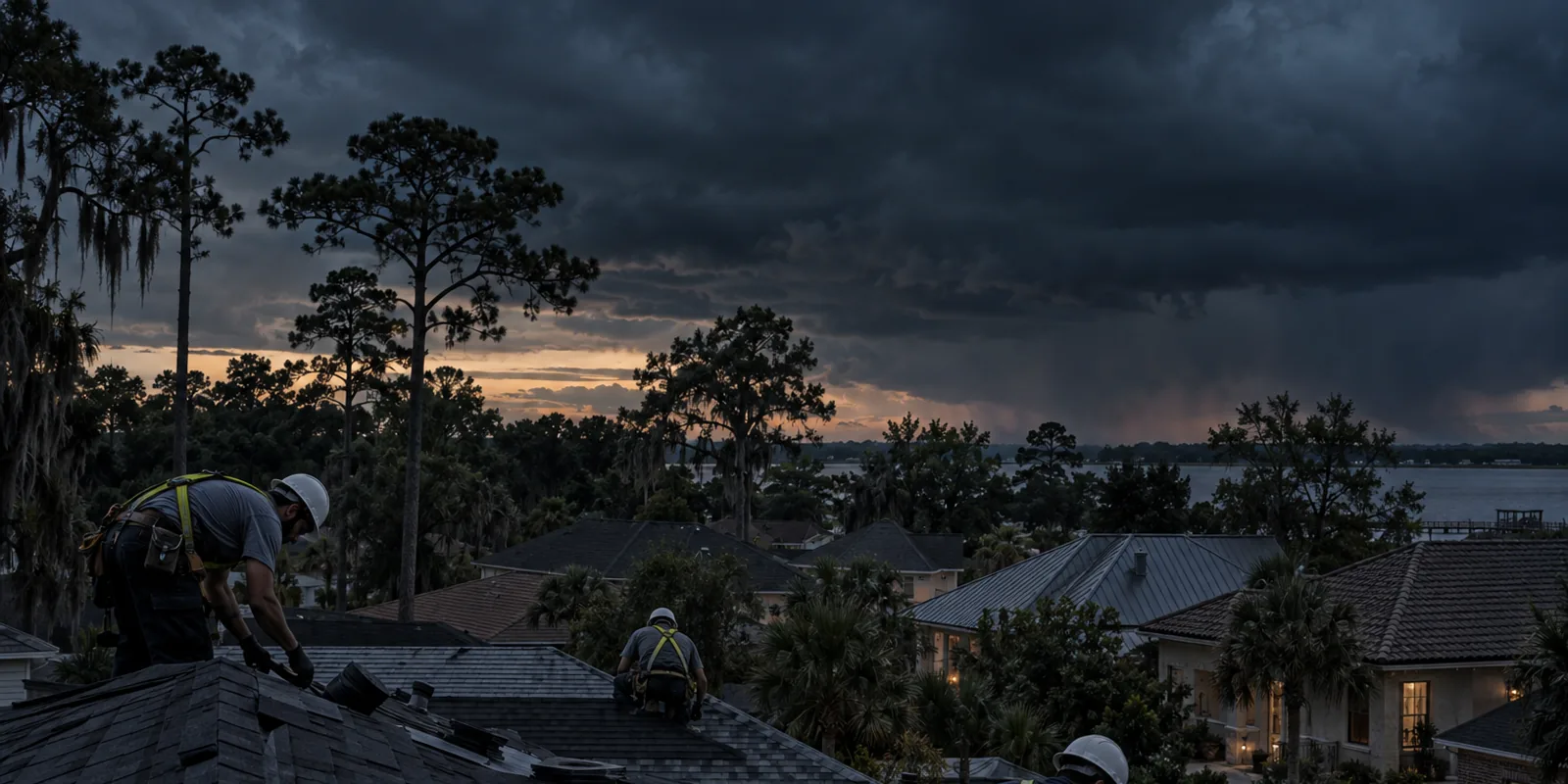
Roofers in Fort Caroline, Jacksonville
Fort Caroline sits on the bluffs where the St. Johns River bends toward the ocean, wrapped by the Timucuan Preserve and some of the heaviest tree cover in Jacksonville. Older ranches and riverfront homes share long, winding streets, and all permits go through the City of Jacksonville.
What usually goes wrong on Fort Caroline roofs
- Limb punctures and heavy leaf and pine needle debris from the dense canopy over older lots
- Algae, moss and lichen on shaded slopes that never fully dry under mature oaks and magnolias
- Aging shingles and flashings on 1960s ranches with original decking that has never been exposed
- Riverfront homes catching more wind, with lifted shingles and rusted flashings on exposed slopes
- Rotted fascia and soffit at eaves where valleys dump onto clogged gutters season after season
Local notes from the roofers
In Fort Caroline the trees are the story. The lots along Fort Caroline Road, Fulton Road and the river streets were cut into old hardwood and pine forest in the 1960s and 1970s, and that canopy is now sixty years bigger. Roofs here stay shaded and damp, so the north and east slopes carry algae streaks, moss and lichen that eat into shingle granules, and every summer thunderstorm or passing tropical system drops limbs that puncture decking and tear off ridge caps. Valleys packed with pine needles back water up under the shingles, and gutters left uncleaned for a season overflow onto the fascia until it rots. Riverfront homes near the Timucuan Preserve add wind exposure across open water, with lifted shingles and corroded flashings on the water-facing slopes. A typical estimate in this part of Jacksonville includes removal of debris, replacement of any punctured or rotted decking, new flashings and often limb trimming before the new roof goes on. Permits come from the City of Jacksonville. Florida insurers pay attention to tree overhang and roof age here, so photos and a clear report help.
Homes and roof types in Fort Caroline
Fort Caroline is a wooded bluff neighborhood along the St. Johns River north of Arlington: 1960s and 1970s brick and block ranches on large treed lots along Fort Caroline Road, riverfront homes with bigger and more complex roofs, and 1980s to 2000s subdivisions off McCormick Road, mostly under architectural shingles with some metal on newer riverfront builds.